
Contenido

Semiconductores Industria
The Practical Guide to Surface Science (2026)

?s=100&d=m
Escrito por
No biography added yet.
leer más
?s=100&d=m
Reviewed by
N/A
No biography added yet.
leer más
?s=100&d=m
Written By

No biography added yet.

?s=100&d=m
Reseña escrita por

N/A N/A

No biography added yet.

This is a practical guide to Surface Science for researchers working in the Semiconductors Industry.

En esta nueva guía aprenderás todo sobre:

  • Principios cruciales de la ciencia de superficies
  • The significance of surface science measurements for the Semiconductors industry
  • Normas y directrices ASTM aplicables

Vamos a sumergirnos en ello.

Semiconductores

Executive Summary

What it covers: A practical surface-science guide for semiconductor R&D and process engineers covering how and why to measure contact angle (static + advancing/receding), surface tension (static + dynamic), surface energy, and sliding angle. It links these measurements to process readiness, troubleshooting, and real manufacturing outcomes.
Key insights: Static contact angles can be misleading on real wafers/coatings—advancing and receding angles (and hysteresis) give a truer, more repeatable read on wettability, cleanliness, roughness, and heterogeneity. It also clarifies method tradeoffs (Young–Laplace profile fitting vs. polynomial fitting) and when dynamic surface tension matters (fast-changing interfaces like droplet formation, coalescence, and drying).
Business value: Improves yield and pattern fidelity by optimizing photoresist/substrate wetting and adhesion in lithography, reducing defects tied to poor surface readiness. Cuts reliability risks and rework in packaging by controlling adhesive flow/residue (sliding angle) and mitigates immersion-lithography failures by tuning fluid surface tension for better drainage/meniscus control.
Standards to follow: Use SEMI/ASTM D7490-13 (Reapproved 2022) to estimate solid surface free energy (total + polar/dispersive components) from two-liquid sessile-drop contact angles as a controlled, comparative “surface readiness” metric. For reproducibility, follow the guide’s reporting checklist: defined probe liquids, droplet volume, fixed capture timepoint, environment (T/RH), replicates/statistics, QC rules, and stated calculation model/liquid set.
Bottom line: This is a semiconductor-focused playbook for choosing the right surface measurement, running it in a controlled way, and interpreting results as process-control signals rather than universal material constants. Use it to set calibrated pass bands, spot contamination/treatment drift early, and tie surface metrics to downstream KPIs like adhesion, defects, and device reliability.

Capítulo 1: Introducción

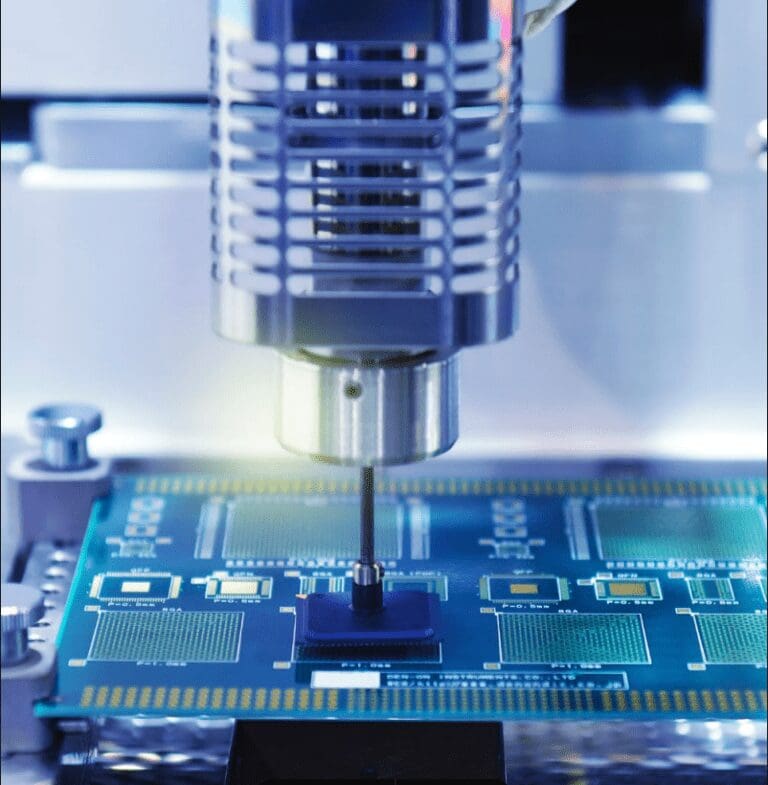
Semiconductor manufacturers face the constant challenge of maximizing performance and refining processes. Often underestimated, surface properties play a crucial role in optimizing these performances. By measuring these properties, we gain valuable insights into material properties, processes, and device performance, ultimately leading to:
 

Semiconductores

We use the following surface properties to understand the behavior of Semiconductors products and improve their quality.

Capítulo 2: Medición del ángulo de contacto

El ángulo de contacto cuantifica la humectabilidad de una superficie representando el ángulo entre la superficie de un líquido y una superficie sólida.
Investigación de Dropletlab

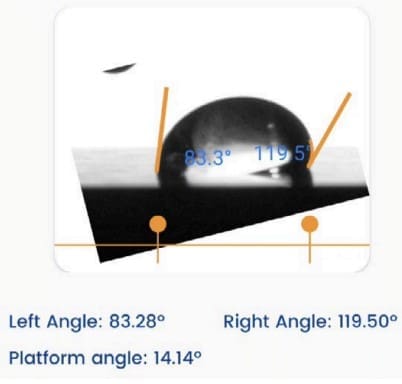
Sample Image taken from Droplet Lab Tensiometer.

Joven – Método Laplace

Método polinómico

Ángulo de contacto dinámico

Ideally, when we place a drop on a solid surface, a unique angle exists between the liquid and the solid surface. We can calculate the value of this ideal contact angle (the so-called Young’s contact angle) using Young’s equation. In practice, due to surface geometry, roughness, heterogeneity, contamination, and deformation, the contact angle value on a surface is not necessarily a single consistent value but rather falls within a range. The upper and lower limits of this range are known as the advancing and receding contact angles, respectively. The values of advancing and receding contact angles for a solid surface are highly sensitive to many parameters, such as temperature, humidity, homogeneity, and minor contamination of the surface and liquid. For example, the advancing and receding contact angles of a surface can differ at different locations.

Ángulo de contacto dinámico frente a ángulo de contacto estático

Las superficies y los recubrimientos prácticos muestran naturalmente histéresis de ángulo de contacto, lo que indica un rango de valores de equilibrio. Cuando medimos ángulos de contacto estáticos, obtenemos un solo valor dentro de este rango. Confiar únicamente en mediciones estáticas plantea problemas, como una repetibilidad deficiente y una evaluación incompleta de la superficie con respecto a la adherencia, la limpieza, la rugosidad y la homogeneidad.

In practical applications, we need to understand how easily a liquid spreads (advancing angle) and how easily it is removed (receding angle), such as in painting and cleaning. Measuring advancing and receding angles offers a holistic view of liquid-solid interaction, unlike static measurements, which yield an arbitrary value within the range.

Esta información es crucial para las superficies del mundo real con variaciones, rugosidad y dinámica, lo que ayuda a industrias como la cosmética, la ciencia de los materiales y la biotecnología a diseñar superficies efectivas y optimizar los procesos.

Aprenda cómo se realiza la medición del ángulo de contacto en nuestro tensiómetro

Para una comprensión más completa de la medición del ángulo de contacto, lea nuestra medición del ángulo de contacto: la guía definitiva

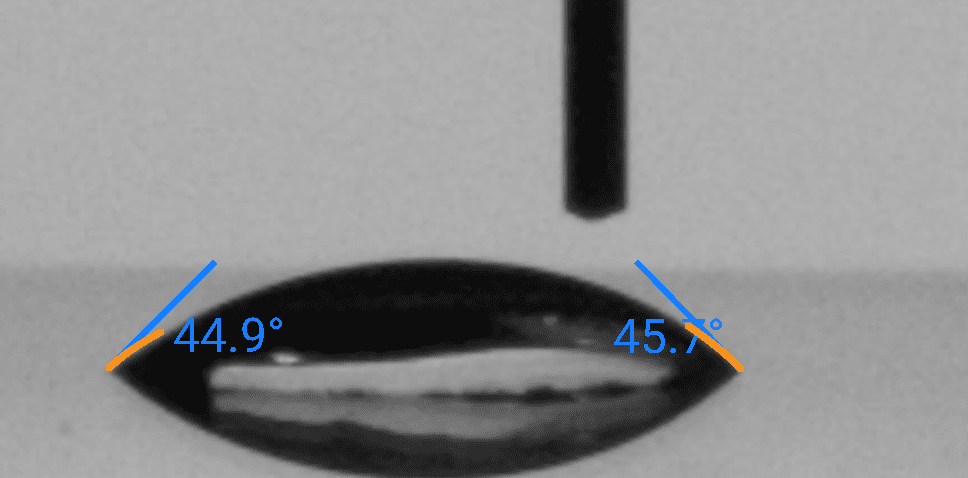
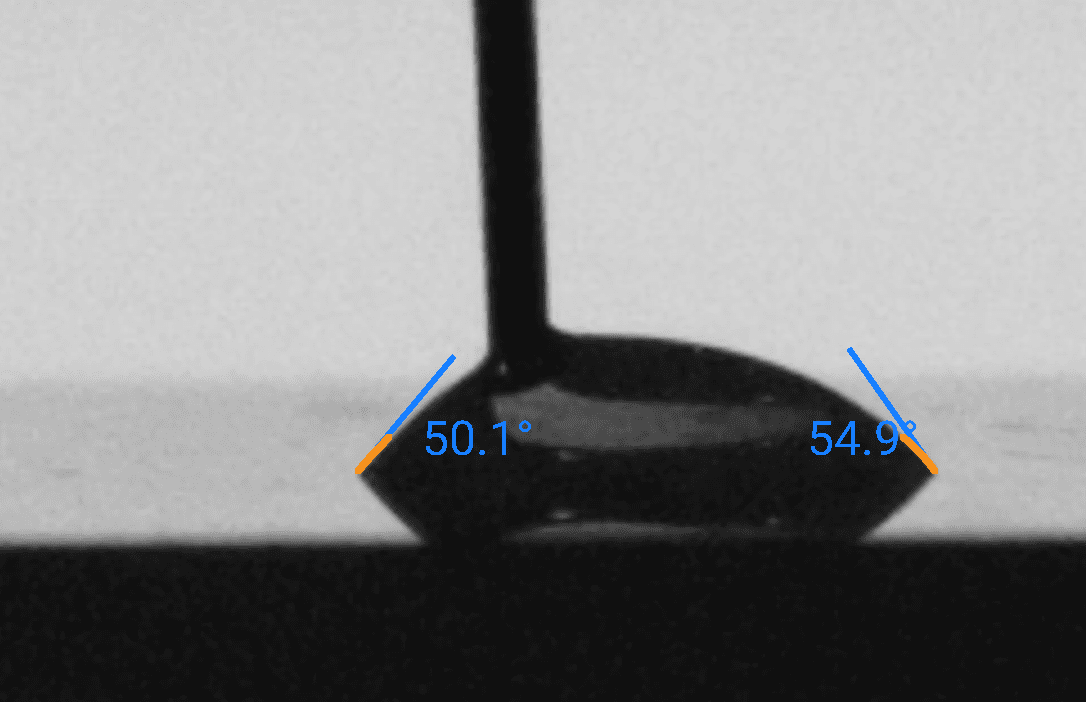
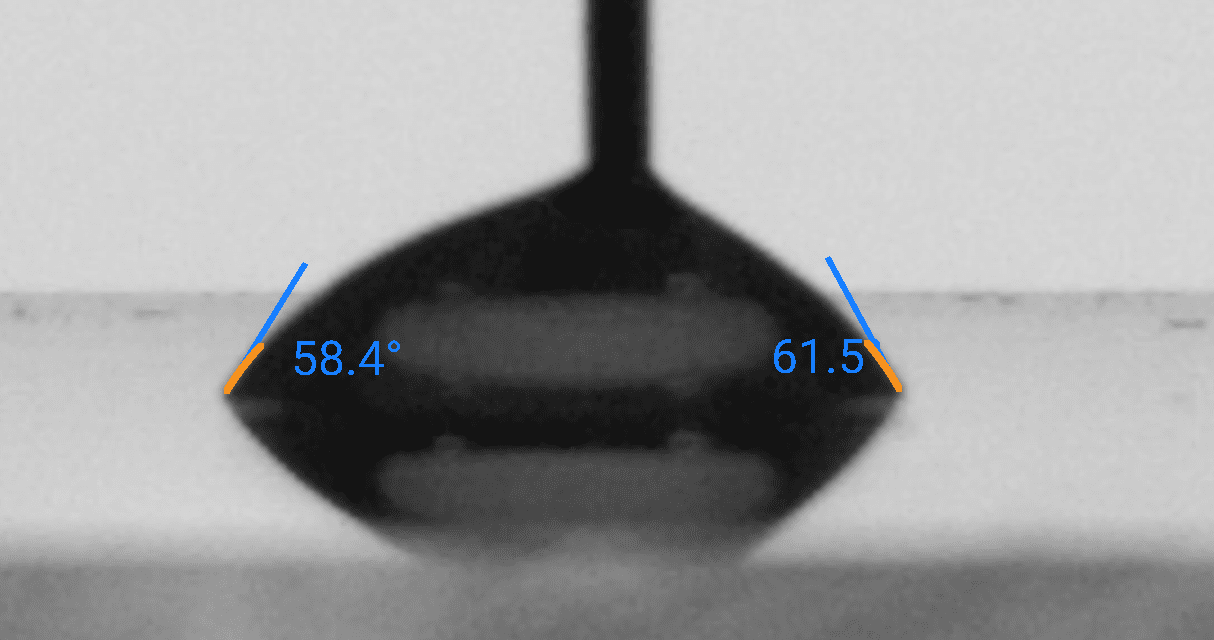
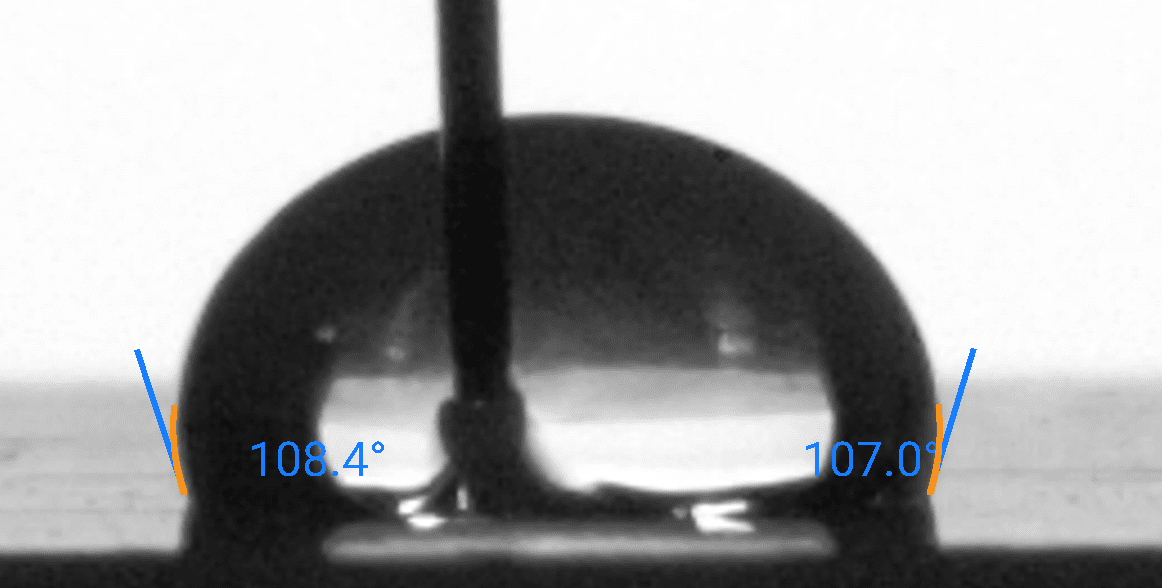
Open Benchmark Data: Contact Angle & Surface Energy

These reference measurements show how deionized water wets four standard substrates measured with the Droplet Lab Dropometer. Use them as visual and numerical benchmarks when you're checking your own sample preparation, treatments, and chemistry.

Full contact angle and surface energy datasets (including additional liquids and statistics) are available on our dataset hub.

Glass - DI Water
Glass - DI Water
Nylon - DI Water
Nylon - DI Water
PMMA - DI Water
PMMA - DI Water
Teflon - DI Water
Teflon - DI Water

The droplet images above are taken from the same benchmark series as our open dataset. For each substrate and probe liquid we report:

● Advancing and receding contact angles (and hysteresis)
● Derived surface energy (SFE) values based on multi-liquid measurements
● Measurement conditions, uncertainties, and sample preparation details

Comparing your own droplet shapes and angles against these references is a fast way to spot contamination, treatment drift, or unexpected changes in wettability.
Capítulo 3: Medición de la tensión superficial

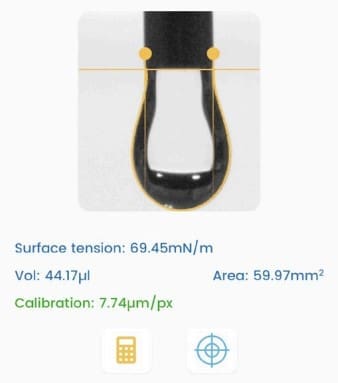
Esta propiedad mide la fuerza que actúa sobre la superficie de un líquido, con el objetivo de minimizar su superficie.

Medición de tensión superficial

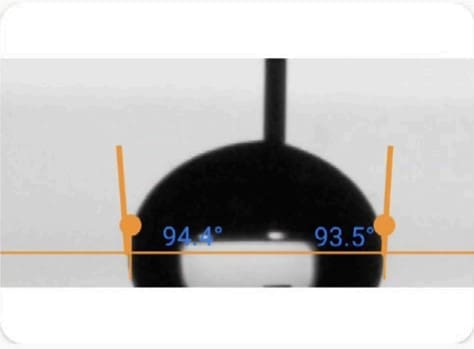
Sample Image taken from Droplet Lab Tensiometer

Tensión superficial dinámica

La tensión superficial dinámica difiere de la tensión superficial estática, que se refiere a la energía superficial por unidad de área (o fuerza que actúa por unidad de longitud a lo largo del borde de una superficie líquida).

La tensión superficial estática caracteriza el estado de equilibrio de la interfaz líquida, mientras que la tensión superficial dinámica explica la cinética de los cambios en la interfaz. Estos cambios podrían implicar la presencia de tensioactivos, aditivos o variaciones en la temperatura, la presión y la composición en la interfaz.

Cuándo utilizar la medición dinámica de la tensión superficial

Dynamic surface tension is essential for processes that involve rapid changes at the liquid-gas or liquid-liquid interface, such as droplet and bubble formation, coalescence (change in surface area), the behavior of foams, and the drying of paints (change in composition, e.g., evaporation of solvent). It is measured by analyzing the shape of a hanging droplet over time.

La tensión superficial dinámica se aplica a diversas industrias, incluidas las cosméticas, los recubrimientos, los productos farmacéuticos, la pintura, los alimentos y las bebidas, y los procesos industriales, donde la comprensión y el control del comportamiento de las interfaces líquidas son esenciales para la calidad del producto y la eficiencia del proceso.

Aprenda cómo se realiza la medición de la tensión superficial en nuestro tensiómetro

Para una comprensión más completa de la medición de la energía superficial, lea nuestra medición de la tensión superficial: la guía definitiva

Capítulo 4: Medición de la energía superficial

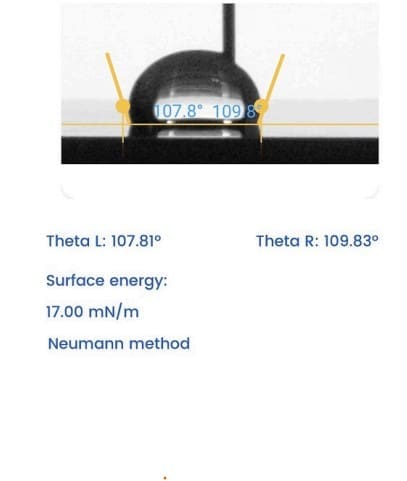
La energía superficial se refiere a la energía requerida para crear una unidad de área de una nueva superficie.
231

Sample Image taken from Droplet Lab Tensiometer

Aprenda cómo se realiza la medición de la energía superficial en nuestro tensiómetro

Para una comprensión más completa de la medición de la energía superficial, lea nuestra medición de la energía superficial: la guía definitiva

For benchmark contact angle and surface energy values on glass, nylon, PMMA, and Teflon, see the Open Benchmark Data panel above or visit our Dataset Hub for full CSV downloads.

Capítulo 5: Medición del ángulo de deslizamiento

El ángulo de deslizamiento mide el ángulo en el que una película líquida se desliza sobre una superficie sólida. Se emplea comúnmente para evaluar la resistencia al deslizamiento de una superficie.

Ángulo de deslizamiento 1

Sample Image taken from Droplet Lab Tensiometer

Aprenda cómo se realiza la medición del ángulo de deslizamiento en nuestro tensiómetro

Para una comprensión más completa de la medición del ángulo de deslizamiento, lea nuestra medición del ángulo de deslizamiento: la guía definitiva

Capítulo 6: Aplicaciones en el mundo real

Within the Semiconductors industry, several case studies exemplify the advantages of conducting surface property measurements.

Photoresist Adhesion in Lithography

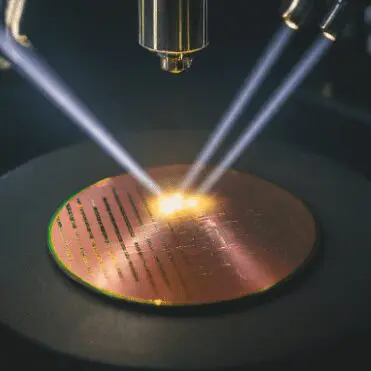
In photolithography, meticulous pattern creation is key to manufacturing complex semiconductor devices. This process relies heavily on the delicate interplay between the photoresist and the substrate. Photoresist adhesion to the substrate acts as a linchpin, directly determining the sharpness and precision of the resulting patterns. To achieve optimal results, manufacturers delve into the surface science of these properties. By examining the substrate's surface energy and analyzing the contact angle exhibited by the photoresist, they gain valuable insights to fine-tune adjustments.

This refining process enhances adhesion properties, ultimately leading to a seamless pattern transfer. The benefits are manifold, including increased yields, sharper results, and a significant reduction in defects throughout the lithography process.
Photoresist Adhesion in Lithography

Reducing Adhesive Residue in Packaging

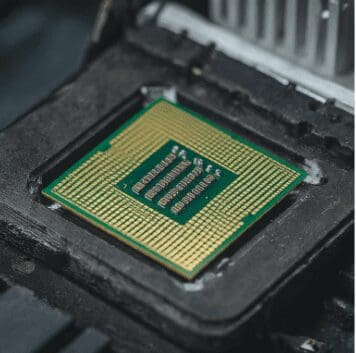
Chip packaging relies heavily on adhesives to securely bind the delicate semiconductor die to its protective casing. However, a major challenge arises from leftover adhesive residue, which can negatively impact device reliability.

To combat this issue, manufacturers meticulously measure and manage the sliding angle of the packaging material during application. This precise control ensures that the liquid adhesive smoothly glides away, leaving no unwanted residue behind. This optimization delivers two key benefits: firstly, it significantly reduces the risk of electrical shorts or unintended connections, and secondly, it effectively boosts the overall electrical performance of the device.
Reducing Adhesive Residue in Packaging

Managing Receding Meniscus in Immersion Lithography

To achieve successful immersion lithography, meticulous management of the immersion fluid is crucial. A major failure point is the receding meniscus event, which leaves residual liquid behind on the wafer as a thin film or droplets. Ideally, the immersion fluid should be confined near the lens, allowing the wafer to scan smoothly during exposure.

For a semiconductor manufacturer, the meniscus failure mechanism remained a significant hurdle, hindering the successful implementation of immersion lithography. Recognizing the critical role of surface forces in drainage and pattern collapse during lithography, they sought a solution from a laboratory. The scientists, understanding the importance, developed a new fluid formulation with precisely tailored surface tension characteristics that facilitated proper liquid drainage, eliminating the meniscus issue.
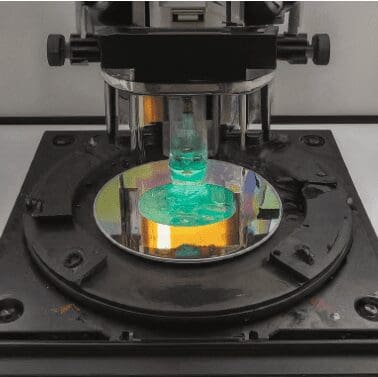
Managing Receding Meniscus in Immersion Lithography

Somos sus socios en la resolución de su negocio y tecnología Desafíos

Si está interesado en implementar estas u otras aplicaciones, póngase en contacto con nosotros.

Capítulo 7: Normas y directrices

In an industry where precision reigns supreme, how can Semiconductors manufacturers ensure their products withstand scrutiny? The answer lies in standards and guidelines: the compass that guides them through the complex maze of quality and performance.

SEMI/ASTM D7490-13 (Reapproved 2022) — Solid Surface Tension (Surface Free Energy) by Two‑Liquid Contact Angle

What it is

Standard practice for estimating a solid’s total surface free energy and separating it into dispersive and polar components by measuring sessile‑drop contact angles of two probe liquids (one polar, one non‑polar) of known surface tension on the surface. It is intended as a quantitative, comparative surface‑readiness metric for wetting/adhesion process control within an approximate applicable range of ~20–60 mN/m.

When to use it

Pre‑print/coat/bond readiness checks

Use fixed‑time contact angles plus calculated γ components to confirm surface cleaning/treatment/priming is within a validated “pass band” before committing to downstream trials.

Process tuning & troubleshooting

Trend γs,polar/γs,dispersive and spot‑to‑spot variability to diagnose under‑treatment, contamination, non‑uniform treatment, or material/lot shifts.

In-scope / Out-of-scope

In scope
  • Substrates/coatings and pigment disks/coupons where sessile drops can be imaged and fit.
  • Two‑liquid contact angle measurements using a defined polar and non‑polar liquid set (commonly water + diiodomethane).
  • Calculation of γs,total and its components (γs,dispersive and γs,polar) using a stated model (e.g., Owens–Wendt / Fowkes‑type).
  • Comparative, protocol‑controlled measurements for QC/process control and investigation.
Out of scope
  • Downstream performance qualification (e.g., peel strength, print quality, environmental aging)—these must be validated separately.
  • Universal “material constants”: results are liquid‑set/model/protocol dependent and should not be compared across different methods without equivalence work.
  • Porous/swelling/absorbing solids without time controls: time‑dependent angles require a defined capture time and QC rules to be meaningful.
  • Liquid surface tension measurement or surface chemistry identification: use other methods/standards for those needs.

Minimum you must report (checklist)

  • Substrate/coating description + history: material, finish, lot, treatment/primer/cleaning steps, side/orientation, and region definition.
  • Probe liquids: identity (polar vs non‑polar), grade/source, lot/date opened, and contamination/purity handling.
  • Measurement geometry + method: sessile drop contact angle; imaging and fitting approach used.
  • Droplet volume + dosing controls: target volume (µL) and how dispensing accuracy is verified/controlled.
  • Capture timepoint + environment: θ @ fixed time (e.g., 2.0 s ± tolerance), temperature, and relative humidity.
  • Replicates + statistics: number of spots per liquid and reporting statistic (e.g., median + IQR), including same‑side/region rules.
  • Measured angles + QC rules: θpolar and θnon‑polar, acceptance criteria, and documentation of any rejected/re‑run spots.
  • Calculated outputs + assumptions: γs,total, γs,dispersive, γs,polar, plus the model and liquid set used for calculation.

This method provides an image‑backed, quantitative surface‑readiness signal but does not by itself guarantee adhesion or print performance. Any pass/fail gates must be calibrated per material family + treatment recipe + ink/adhesive system by correlating D7490 outputs to your downstream KPI.

How to interpret results (guardrails)

  • Use as a controlled comparative metric: keep the protocol fixed and do not mix models or liquid sets when trending or setting limits.
  • Focus on γs,polar for treatment sensitivity (with controls): interpret trends relative to your “golden sample” and validated pass band, not as a standalone promise of adhesion.
  • Treat variability as a first‑class signal: high IQR/spot‑to‑spot spread often indicates non‑uniform treatment or contamination even when the median looks acceptable.
  • Respect applicability and time dependence: if angles change with time due to absorption/swelling, only compare results at the defined capture time and flag unstable droplets for re‑test.

Ahora te toca a ti

We hope this guide showed you how to apply surface science in the Semiconductors industry.

Ahora nos gustaría entregárselo a usted:

Feel free to leave a comment below—we’d love to hear from you.

Contesta

Su dirección de correo electrónico no será publicada. Los campos obligatorios están marcados *