



Contenido
Case Study

A membrane lab asked whether we could measure oil under water. We supplied the cuvette, and five years on the same instrument tests liquid repellent membranes.

Last Updated
October 18, 2026
Industria
Environmental engineering research, membranes
Location
Gwangju, South Korea
Customer since
2021
Medidas
Contact angle, sliding angle, surface tension, surface energy
Drop shape method validated against a KRÜSS DSA100E in peer review Two peer reviewed validation papers Custom cuvette and PTFE holders supplied to the lab's request

The Environmental Nanotechnology Lab at the Gwangju Institute of Science and Technology (GIST), South Korea, needed to characterise the wettability of its membranes, including the contact angle of oil under water. Droplet Lab supplied an automatic Dropometer with all four measurements, a custom glass cuvette and machined PTFE holders. Today a researcher in the lab uses it for static contact angle and sliding angle on liquid repellent membranes.

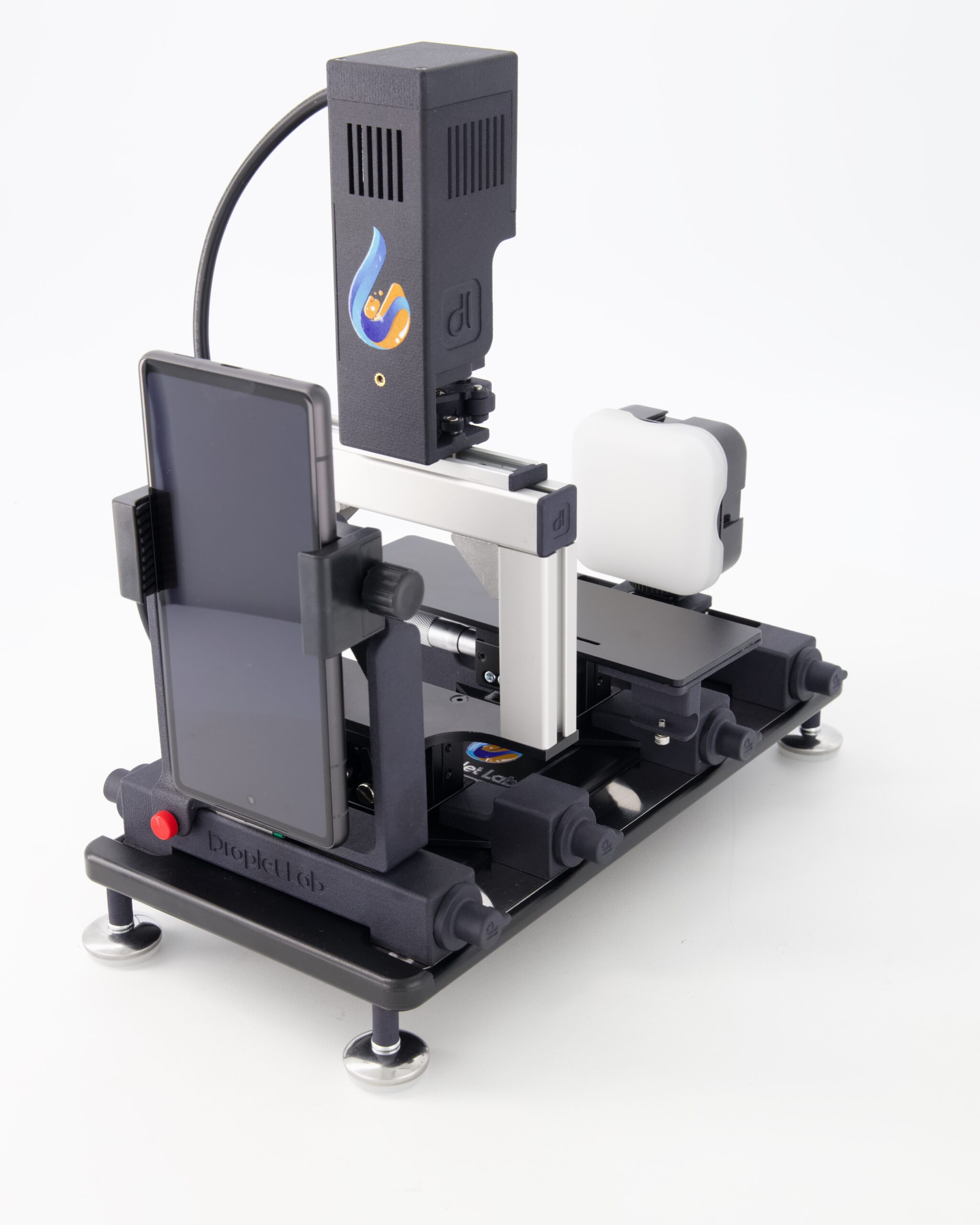
Product photo: a Droplet Lab Dropometer with the automatic dropper. Not a photo of the GIST lab.
Abhimanyu Photo
Escrito por
Abhimanyu Bhandankar
Holds an MBA from Schulich School of Business and a BE in IT. He joined Droplet Lab in July 2019 and now leads sales and marketing.
CEO at Droplet Lab
leer más
Gurdeep-Saini-Photo
Technical Review by
Gurdeep Singh Saini
Holds a BASc in Mechanical Engineering from Ryerson University (now Toronto Metropolitan University) and an MASc from York University. He develops the automatic edge and baseline detection behind the Dropometer's analysis.
COO at Droplet Lab
leer más
Abhimanyu Photo
Written By

Abhimanyu Bhandankar

CEO at Droplet Lab

Holds an MBA from Schulich School of Business and a BE in IT. He joined Droplet Lab in July 2019 and now leads sales and marketing.

Gurdeep-Saini-Photo
Reseña escrita por

Gurdeep Singh Saini

COO at Droplet Lab

Holds a BASc in Mechanical Engineering from Ryerson University (now Toronto Metropolitan University) and an MASc from York University. He develops the automatic edge and baseline detection behind the Dropometer's analysis.

Primary outcome: one instrument for membrane wetting, customised for oil under water, still in use five years later

Years in use at the lab

Delivered August 2021, activation renewed in August 2026

Measurements available 4 of 4
Years in use to date 5

The lab received its Dropometer on 13 August 2021, with a custom glass cuvette y machined PTFE holders for measuring under liquid. In 2023 it installed a software upgrade. In August 2026 a newer researcher updated the app and received a replacement activation code the same day. He uses the instrument for static contact angle y Ángulo de deslizamiento on membranes developed for liquid repellency. The lab has not yet shared measurement data, so this page reports the setup and its use.

4 measurements

Contact angle, sliding angle, surface tension and surface energy on one instrument.

50 mm

Path length of the custom glass cuvette for measurements under liquid.

5 years

In use at the lab since August 2021.

2 researchers

Used by at least two researchers in the lab since 2021.

Executive Summary

Who

The Environmental Nanotechnology Lab in the School of Earth Science and Environmental Engineering at the Gwangju Institute of Science and Technology (GIST), South Korea. The lab works on membrane technology. A current researcher develops and characterises membranes for liquid repellency and surface adhesion.

Problem

Membrane research needs wettability data, and the lab also wanted the contact angle of oil under water, which a standard sessile drop setup cannot measure. Its samples are often rough and give little reflection, which makes the drop edge harder to find. As a government supported institute, it also had to buy through a local agent.

Solución

An automatic Dropometer with contact angle, surface tension, surface energy and sliding angle, an automatic dropper and an automatic tilting stage. Droplet Lab sourced a glass cuvette to the lab's size and machined PTFE holders, so samples can be held under liquid.

Time to Value

9 March 2021: first enquiry. 10 March 2021: oil under water confirmed as possible. April 2021: decision to buy. 28 April to 10 May 2021: cuvette chosen and PTFE holder approved. 22 June 2021: purchase order through a Korean agent. 13 August 2021: instrument received. July 2023: software upgrade installed. 24 August 2026: replacement activation code sent the same day it was requested.

Results

The instrument arrived in August 2021 and is still in use five years later. After a 2023 software upgrade the original user wrote that the new sessile app looks fancy. In 2026 a newer researcher in the lab described using it for static contact angle and sliding angle to judge the liquid repellency of membranes.

Highlights

4

Measurements on one instrument

50 mm

Custom cuvette path length

2021

Delivered

2026

Still in use

GIST Environmental Nanotechnology Lab, at a glance

Research focus

Membrane technology, now membranes developed for liquid repellency.

Products / applications

Membranes for environmental engineering, characterised for liquid repellency and surface adhesion.

Measurement stage

Laboratory research.

Users

Researchers in the lab; the original buyer has since graduated and a newer researcher now uses it.

Materials and surfaces tested

Membranes, many of them rough with little reflection; oil under water was part of the original request.

Key constraints

Rough samples, measurements under liquid, purchase through a local agent, and support from another continent.

The challenge: membrane wetting, including oil under water

Membranes are judged by how liquids meet them, and not only in air.

Why membranes need wetting data

A membrane's wettability decides how water and oil meet it. The lab told Droplet Lab that its membrane work usually needs wettability characterised, and asked about oil under water from the first message. Our use case page on membrane hydrophobicity and fouling characterization covers why these readings matter for membranes. Water repellency is also judged by contact angle on polymeric outdoor insulators, where contact angle supports the IEC TR 62039 selection guidelines. Our Utilities guide gathers these applications in one place.

Measuring under liquid

The contact angle of oil under water cannot be measured on an open stage. The sample has to sit inside a clear cell filled with water, with the drop placed from below or beside it and imaged through the glass. The same idea underlies the captive bubble method, which measures an air bubble held against a sample under liquid.

Rough samples

Most of the lab's samples are rough and give little reflection, so the line where the drop meets the surface is harder for the software to find than on smooth glass. Our guide to contact angle measurement explains how the baseline is set, and our page on reproducible contact angle measurement covers lighting and focus on difficult samples.

What success would require

A cuvette and holder that fit the lab's samples, all four measurements on one instrument, and remote support to set it up from the other side of the world. Our buying guide to contact angle goniometers for advanced research covers how to weigh these needs when choosing an instrument.

The insight: hold the sample under liquid, and keep the rest of the instrument standard

What Was Deployed

An automatic Dropometer contact angle and surface tension kit with all four measurements: contact angle, surface tension, surface energy and sliding angle. It was ordered with the automatic dropper and an automatic tilting stage for sliding angle. For measurements under liquid, Droplet Lab sourced a glass cuvette with a 50 mm path to the lab's requested size, machined PTFE blocks to hold samples inside it, and microscope slides. The custom parts were checked for fit before the instrument shipped. Static contact angle and sliding angle together show how strongly a surface repels a liquid. Our classroom experiment that makes a water repellent glass surface with a flame shows both readings on a simple sample. A published thesis on ski wax and friction at the ski snow interface also used contact angle. It compared fluorinated, non fluorinated and bio based waxes. When the lab shares results, they can be compared with our Droplet Lab reference measurement dataset.
The Origin

“Would this product measure the underwater oil contact angle?”

On 9 March 2021 a researcher in the lab filled in Droplet Lab's website form. The lab works on membrane technology and needs to characterise wettability, and the first question was whether the Dropometer could measure the contact angle of oil under water.

The next day, Droplet Lab confirmed it could. Dr Alidad Amirfazli, Co-founder and Scientific Advisor, advised that it needs a cuvette with side walls of about 2 to 3 cm. The lab decided to buy in April 2021, chose a cuvette on 28 April and approved a PTFE holder on 10 May. Because GIST is a government supported institute, the order went through a Korean agent, and the purchase order followed on 22 June 2021.

Rollout timeline

Timeline (high level)

March to May 2021: Enquiry and custom parts

  • Website enquiry about oil under water on 9 March
  • Cuvette size chosen and PTFE holder approved
  • Decision to buy in April

June to August 2021: Order and delivery

  • Purchase order through a Korean agent on 22 June
  • Shipped on 2 August after work on the tilting stage
  • Received on 13 August

August to October 2021: Setup and support

  • Assembly and measurement videos and guides sent
  • Advice on finding the drop edge on rough samples

2022 to 2023: Feedback and upgrade

  • Written feedback from the lab in 2022
  • Free software upgrade in 2023

August 2026: New researcher

  • Replacement activation code sent the same day it was requested
  • Static contact angle and sliding angle on the lab's liquid repellent membranes

Proof and validation: what we can show so far

Test method

Static contact angle and sliding angle on membranes developed for liquid repellency, measured on an automatic Dropometer. Liquids, drop volumes and values have not yet been shared.

Sample size and operators

Researchers in the Environmental Nanotechnology Lab. Sample numbers not shared.

Repeatability / reproducibility

No customer data shared yet. We will add results only after the lab shares them and approves their use.

Notes / assumptions

Early on, the software struggled to find the drop edge on rough samples with little reflection. Droplet Lab's engineer advised raising the brightness setting or moving the light closer. The lab's use of the cuvette for oil under water has not been confirmed with results.

Outcomes to date

Measured Outcomes

5 years

In use

From delivery in August 2021 to active use by a newer researcher in 2026.

4

Medidas

Contact angle, sliding angle, surface tension and surface energy on one instrument.

2

Users

Now used by a researcher who joined after the original buyer, with a replacement activation code sent the same day he asked.

Operational Outcomes

Custom setup

A cuvette and PTFE holders made for measurements under liquid.

Liquid repellent membranes

Static contact angle and sliding angle used to judge liquid repellency and surface adhesion.

Kept current

Software upgraded in 2023 and activation renewed in 2026.

What's next

Delivered

Automatic Dropometer with all four measurements, cuvette and PTFE holders
Software upgrade (2023) and activation renewal (2026)

In Pilot

Static contact angle and sliding angle on liquid repellent membranes

Planned

Add the lab's measured results to this page once it shares and approves them

Frequently asked questions

Can the Dropometer measure the contact angle of oil under water?

Yes, with the sample held under liquid. For this lab Droplet Lab sourced a glass cuvette with a 50 mm path to the lab's requested size and machined PTFE holders to keep samples inside it. The custom parts were checked for fit before the instrument shipped.

How does the lab use the instrument today?

A researcher in the lab measures static contact angle and sliding angle to judge the liquid repellency of membranes. The instrument has all four measurements, an automatic dropper and an automatic tilting stage, and arrived in August 2021.

Can a government supported institute buy through a local agent?

Yes. GIST placed its purchase order through a Korean agent on 22 June 2021, and the instrument was received on 13 August 2021. Support has continued by email from Canada, including a 2023 software upgrade.

Next Step

Testing liquid repellency or underwater wetting on membranes?

The Dropometer measures static contact angle, sliding angle, surface tension and surface energy, and can be set up with a cuvette for measurements under liquid. The drop shape method is validated against a KRÜSS DSA100E in peer review. Book a 15-minute consult about a membrane sample, or request a quote.