Contenido
Cleanliness, Residue and Contamination Verification

Silicone contamination detection and residue testing for surface cleanliness verification

Stop dewetting, fish-eyes, and adhesion failures caused by silicone contamination and invisible residue with fast, quantitative surface testing.

Who this is for: QA/QC teams, process engineers, and manufacturing leaders responsible for detecting silicone contamination before coating, bonding, printing, or assembly.
Escrito por
Technical Marketing (Surface Science)
Reviewed by
Surface Science Specialist
Last updated
2026-02-12
Escrito por
zoya
No biography added yet.
leer más
Technical Review by
Equipo de laboratorio de gotas
Droplet Lab builds precision instruments and software for surface science measurement, specialising in contact angle analysis and surface tension characterisation. Used by researchers across materials science, pharmaceuticals, coatings, and advanced manufacturing, Droplet Lab's Dropometer has contributed to studies published in peer-reviewed journals including Advanced Functional Materials (Impact Factor 19). The team combines instrument engineering with deep domain knowledge in wettability science with a focus on practical accuracy.

leer más
Written By

No biography added yet.

Reseña escrita por

Equipo de laboratorio de gotas

Droplet Lab builds precision instruments and software for surface science measurement, specialising in contact angle analysis and surface tension characterisation. Used by researchers across materials science, pharmaceuticals, coatings, and advanced manufacturing, Droplet Lab's Dropometer has contributed to studies published in peer-reviewed journals including Advanced Functional Materials (Impact Factor 19). The team combines instrument engineering with deep domain knowledge in wettability science with a focus on practical accuracy.


QC-Ready Summary

What this workflow does and what it does not

Quick technical reference for engineers and QA managers evaluating fit before reading further.

Evidence Box (QC-Ready)

Problem this solves

Silicone contamination—including thin films of silicone oil residue from mold release, lubricant transfer, or silicone-based materials—creates invisible surface contamination that disrupts wetting, coating, and adhesive bonding performance.

Dropometer role in workflow

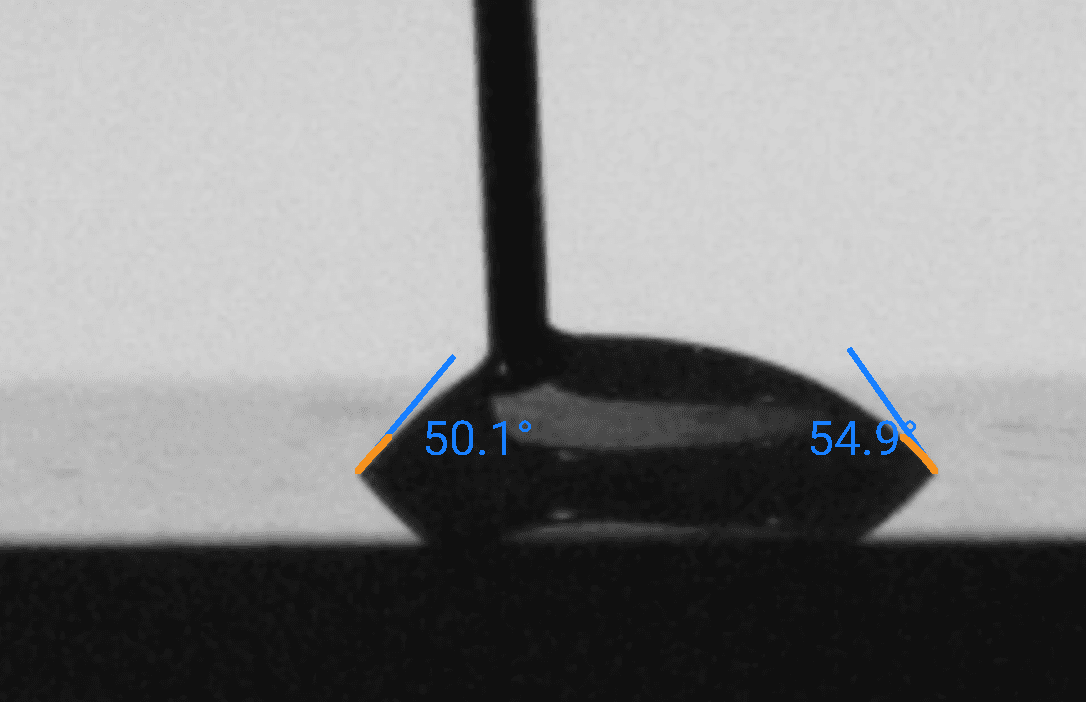
A rapid silicone detection system for surface cleanliness verification using water contact angle (WCA) and variability mapping to detect silicone contamination before defects occur.

Primary outputs

Contact angle (10°–175°, high precision)
Static + dynamic (advancing/receding) angles
Surface energy modeling (Fowkes, vOCG, Equation of State)
Pendant drop surface tension (Young–Laplace)

Calibration requirement

Establish process-specific baselines and correlate to adhesion, coating, or defect outcomes—no universal detection limit applies.

Protocol defaults (starting point)

Probe liquid: DI water (sensitive to silicone oil contamination)
Fixed droplet volume + time
≥5 measurements per zone
Report median + IQR for robust data collection

Known limitations

Contact angle indicates contamination risk, not chemical identity
Rough or polymer surfaces increase variability
Confirm silicone via spectroscopy (FTIR, XPS) when required

Use-case navigator

What are you trying to solve?

Choose the operating problem first. This lets you frame the rest of the workflow around throughput pressure, failure investigation, or pre-bond quality control.

workflow fit

Is this the right screen for your process?

This is not a universal solution. Check the conditions below before investing further time.

Good fit if

Less relevant if

Executive Summary

What this page helps you decide quickly

Silicone contamination is often invisible to the naked eye yet highly disruptive to surface quality. Even trace silicone oil or silicone-based residues can alter adhesive properties, prevent coating wetting, and cause adhesion failures in manufacturing processes across industries—from automotive paint lines to medical devices.

This use case introduces a practical silicone detection technique using Dropometer:

  1. Surface cleanliness gate: Water contact angle testing detects silicone contamination rapidly.
  2. Variability mapping: Identifies localized contamination from handling, lubricant transfer, or release agents.
  3. Escalation path: When required, confirm with laboratory analysis using FTIR, XPS, or infrared spectroscopy.

Outcome: Faster detection of silicone contamination issues, reduced scrap, improved coating and adhesive performance, and standardized quality control across production environments.

Silicone contamination and invisible residue

<p data-start="3076" data-end="3316">Silicone contamination from silicone lubricant, mold release agents, or silicone-containing products forms thin residual films on surfaces. These films reduce surface energy and interfere with coating, paint, and adhesive bonding processes.</p> <p data-start="3318" data-end="3424">Because this contamination is often invisible, traditional inspection fails—leading to late-stage defects.</p>

  • Coating defects such as fish-eyes or craters
  • Poor paint wetting or uneven coating coverage
  • Adhesion failures in bonding or sealing
  • Ink beading on plastic or polymer surfaces
  • Random, non-repeatable contamination issues
  • Surface quality inconsistencies across batches

Why It Happens

Why:

  • Silicone oil spreads easily and forms ultra-thin films with low surface energy.

How to detect:

  • Elevated water contact angle vs baseline

Corrective action:

  • Eliminate silicone-based release agents or isolate processes

Why:

  • Gloves, tapes, liners, and even hand creams introduce contaminants.

How to detect:

  • High variability (IQR) and hotspot mapping

Corrective action:

  • Redefine handling protocols and material selection

Why:

  • Silicone is difficult to remove; standard solvent cleaning may leave residual contamination.

How to detect:

  • Partial improvement in contact angle but not baseline recovery

Corrective action:

  • Optimize cleaning chemistry and sampling validation

Why:

  • Plasma or corona treatment inconsistencies affect surface energy distribution

How to detect:

  • Acceptable average WCA but high spatial variability

Corrective action:

  • Improve treatment uniformity and monitoring

Not sure which root cause applies to your process?

A surface science specialist can review your failure history and help you identify whether a surface screen would add a useful upstream gate.

For Compliance Officers and QA Managers

Building a defensible pre-bond inspection record

Surface readiness measurement produces the type of numeric, traceable output that subjective visual methods cannot. If your quality system requires documented evidence of process control at each stage for NCR responses, CAPA files, incoming inspection records, or supplier audits contact angle measurement provides that evidence in a format your QA documentation already requires.

What to Measure

Water contact angle (WCA)

Why it matters: Primary indicator for detecting silicone contamination

How to interpret: Higher WCA → increased contamination risk

When it is not enough: Cannot uniquely identify silicone vs other contaminants

Spot-to-spot variability (IQR/SD)

Why it matters: Reveals invisible contamination patterns

How to interpret: High variability → localized contamination

When it is not enough: Does not identify contaminant type

Advancing/receding angles (hysteresis)

Why it matters: Sensitive to heterogeneity and weak boundary layers

How to interpret: Increased hysteresis indicates contamination or roughness

When it is not enough: Requires stricter protocol control

Surface free energy (model-based analysis)

Why it matters: Differentiates intrinsic surface properties from contamination

How to interpret: Use trends, not absolute values

When it is not enough: Model-dependent and indirect

Pendant drop surface tension

Why it matters: Ensures probe liquid consistency

How to interpret: Detects contamination in test liquids

When it is not enough: Not a surface contamination measurement

Validated measurement approach

Independent benchmarking and publication-based validation references.

Benchmark Validation

Our Contact angle and pendant‑drop surface tension methods have been benchmarked against KRÜSS DSA100E reference measurements.

See peer‑reviewed validation

Publication Evidence

Our instruments are referenced in peer‑reviewed journals, theses, and conference publications

Browse the full citations list

How Dropometer Fits Your Workflow

Pre-bond screening and triage flow mapped to release decisions

1

Establish baseline

Define “clean” surface using controlled samples and validated downstream performance.

2

Add silicone detection gate

Perform water contact angle testing after cleaning or surface prep.

3

Map contamination

Use spatial data collection to uncover contamination sources.

4

Escalate if needed

Confirm with laboratory analysis using:

  • Fourier Transform Infrared Spectroscopy (FTIR)
  • X-ray Photoelectron Spectroscopy (XPS)
  • Spectroscopic surface analysis

“We completed our gage R&R study on the unit and it performed very well.”

Brandon Barbee, Corporate Quality Engineer - Zeus Industries - Polymer Manufacturing

Download the Pre-Bond Surface Screening SOP Template

An editable SOP template your team can adapt for your substrate, adhesive, and preparation route. Includes measurement protocol, gate-setting guidance, and a QC log format ready for your documentation system.

Baseline + gates (calibration first)

PASS: WCA within baseline + low variability
MONITOR: Increasing WCA or variability trend
FAIL: High WCA or strong contamination pattern

Recommended calibration study

  • Known clean vs contaminated samples
  • Multi-operator validation
  • Correlation with adhesion failures and defects

QC-Ready Quick Protocol (SOP Card)

Simple checklist for pre-bond release gating

Goal: Prevent adhesive failure before bonding by screening surface readiness and triggering corrective actions before assembly.

Sample Handling

  • Avoid contamination from gloves or environment
  • Control storage and exposure

Setup

  • Use consistent droplet volume
  • Include control sample

Measurement

  • ≥5 spots per surface
  • Fixed timepoint measurement
  • Record median + IQR

Release Rules

  • Verify probe liquid integrity
  • Repeat compromised measurements

Decision Tree (Triage)

It shows whether the surface is wetting the test liquid consistently enough to support your site-defined pre-bond screening criteria.

Instant ROI Snapshot

Calculate your savings in real time

Instant ROI Snapshot

Calculate your savings in real time.

Result

≈0
hrs/month saved
≈$0
/month ROI

Where do these numbers come from? i You enter your current total time per test (dispense + record + analyze + save). The calculator assumes that our Dropometer reduces that workflow to ~1.1 minutes per test (dispense + capture + automated fit + export). Time saved per test = max(0, your time − 1.1 min). Monthly hours saved = (monthly tests × minutes saved per test) ÷ 60, and monthly savings = hours saved × labor rate.

Pitfalls + Limits

Use these guardrails when communicating and operationalizing results

  • No universal threshold for silicone detection
  • Contact angle ≠ chemical identification
  • Surface roughness affects results
  • Requires consistent protocol

Use wetting metrics as an upstream quality gate, then confirm final suitability with your established bond-strength acceptance tests.

How this page was created

Editorial and technical transparency notes for this page.

Transparency Details 4 checklist items
01

Drafting assistance

Initial draft created with AI assistance (ChatGPT 5.2 Pro), then rewritten for technical clarity.

02

Technical review

Reviewed and edited for technical accuracy by a surface-science specialist.

03

Verification steps

Identifiers, units, thresholds, and key claims checked against cited sources before publication.

04

Updates

Reviewed every 12 months or when the underlying standard changes.

Report a correction

Spotted an issue in this summary? Send a correction request and our team will review it.

Correction Request

We work hard to keep this standards summary accurate and up to date. If you spot an error (wrong revision/year, missing requirement, incorrect interpretation, or broken link), tell us and we'll review it.

Contact us to report a correction

Referencias

1. Contact-angle-derived surface property measurement is widely used to support wetting and adhesion interpretation when correlated to performance outcomes.
2. Bond failures are commonly driven by surface preparation/contamination and cure-control issues rather than adhesive chemistry alone.