





Contenido

Productos químicos Industria
The Practical Guide to Surface Science (2026)

?s=100&d=m
Escrito por
No biography added yet.
leer más
?s=100&d=m
Reviewed by
N/A
No biography added yet.
leer más
?s=100&d=m
Written By

No biography added yet.

?s=100&d=m
Reseña escrita por

N/A N/A

No biography added yet.

This is a practical guide to Surface Science for researchers working in the Chemicals Industry.

En esta nueva guía aprenderás todo sobre:

  • Principios cruciales de la ciencia de superficies
  • The significance of surface science measurements for the Chemicals industry
  • Normas y directrices ASTM aplicables

Vamos a sumergirnos en ello.

chemical

Executive Summary

What it covers: A practical guide to the four core surface measurements—contact angle (static + advancing/receding), surface tension (static + dynamic), surface energy, and sliding angle—and how to apply each in chemicals R&D, formulation, and QC. It also links measurement choices to real production problems like wetting defects, dispersion stability, and adhesion failures.
Key insights: Advancing/receding (dynamic) contact angles give a more realistic picture of wettability on real, imperfect surfaces than a single static value, and Young–Laplace vs. polynomial fitting is a repeatability vs. flexibility trade-off. Use dynamic surface tension when interfaces evolve quickly (droplet/bubble formation, foams, solvent evaporation/drying), and treat benchmark datasets/images as fast “sanity checks” to catch contamination or treatment drift.
Business value: Better control of surface properties improves nanoparticle dispersibility, coating/substrate adhesion, and emulsion stability—reducing rejects, rework, and troubleshooting time. In sustainability-focused production, surface measurements help optimize catalysts and wetting/interaction behavior to cut waste and energy use while improving consistency.
Standards to follow: Use ASTM D7334 for advancing contact angle practice and the ISO 19403 series for reproducible wettability/SFE, dynamic angles, and roll-off/sliding behavior in R&D and QC. For liquid coatings, follow EN ISO 19403‑3 for pendant-drop surface tension (and cite the exact revision/edition used to keep QC trending comparable).
Bottom line: This is a standards-aligned, shop-floor-to-lab playbook for choosing the right surface measurement at the right time—and interpreting it in a way that improves product reliability, speeds root-cause work, and strengthens formulation decisions. It turns surface science from “nice-to-have data” into an operational tool for tighter QC and better-performing chemical products.

Capítulo 1: Introducción

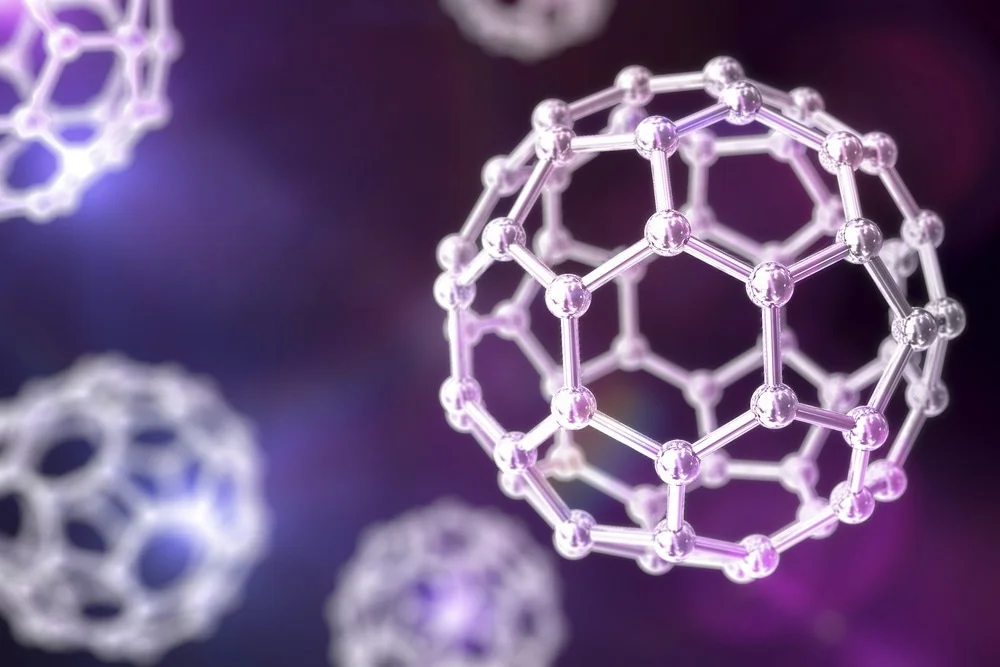
The surface properties of materials significantly impact the chemical industry, influencing product quality, performance, and consumer satisfaction. Understanding surface tension, contact angle, sliding angle, and surface energy enables the development of chemicals and materials with superior adhesion, dispersibility, and stability.

In addressing the chemical industry’s challenges—such as creating high-performance products, and ensuring product stability and longevity—precision, innovation, and efficiency are essential. Surface science offers critical insights into surface interactions, interfacial phenomena, and material compatibility, providing a foundation for optimizing chemical production methodologies.

We use the following surface properties to understand the behavior of Chemicals products and improve their quality.

Capítulo 2: Medición del ángulo de contacto

El ángulo de contacto cuantifica la humectabilidad de una superficie representando el ángulo entre la superficie de un líquido y una superficie sólida.
Investigación de Dropletlab

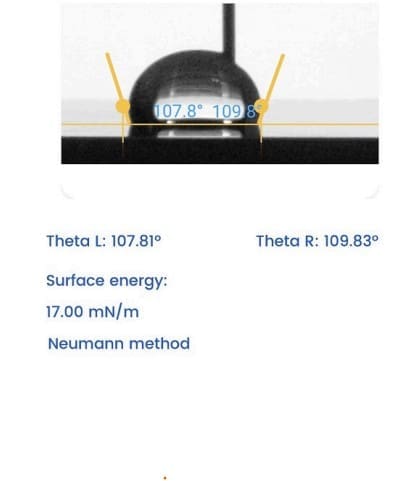
Sample Image taken from Droplet Lab Tensiometer.

Joven – Método Laplace

Método polinómico

Ángulo de contacto dinámico

Ideally, when we place a drop on a solid surface, a unique angle exists between the liquid and the solid surface. We can calculate the value of this ideal contact angle (the so-called Young’s contact angle) using Young’s equation. In practice, due to surface geometry, roughness, heterogeneity, contamination, and deformation, the contact angle value on a surface is not necessarily a single consistent value but rather falls within a range. The upper and lower limits of this range are known as the advancing and receding contact angles, respectively. The values of advancing and receding contact angles for a solid surface are highly sensitive to many parameters, such as temperature, humidity, homogeneity, and minor contamination of the surface and liquid. For example, the advancing and receding contact angles of a surface can differ at different locations.

Ángulo de contacto dinámico frente a ángulo de contacto estático

Las superficies y los recubrimientos prácticos muestran naturalmente histéresis de ángulo de contacto, lo que indica un rango de valores de equilibrio. Cuando medimos ángulos de contacto estáticos, obtenemos un solo valor dentro de este rango. Confiar únicamente en mediciones estáticas plantea problemas, como una repetibilidad deficiente y una evaluación incompleta de la superficie con respecto a la adherencia, la limpieza, la rugosidad y la homogeneidad.

In practical applications, we need to understand how easily a liquid spreads (advancing angle) and how easily it is removed (receding angle), such as in painting and cleaning. Measuring advancing and receding angles offers a holistic view of liquid-solid interaction, unlike static measurements, which yield an arbitrary value within the range.

Esta información es crucial para las superficies del mundo real con variaciones, rugosidad y dinámica, lo que ayuda a industrias como la cosmética, la ciencia de los materiales y la biotecnología a diseñar superficies efectivas y optimizar los procesos.

Aprenda cómo se realiza la medición del ángulo de contacto en nuestro tensiómetro

Para una comprensión más completa de la medición del ángulo de contacto, lea nuestra medición del ángulo de contacto: la guía definitiva

Open Benchmark Data: Contact Angle & Surface Energy

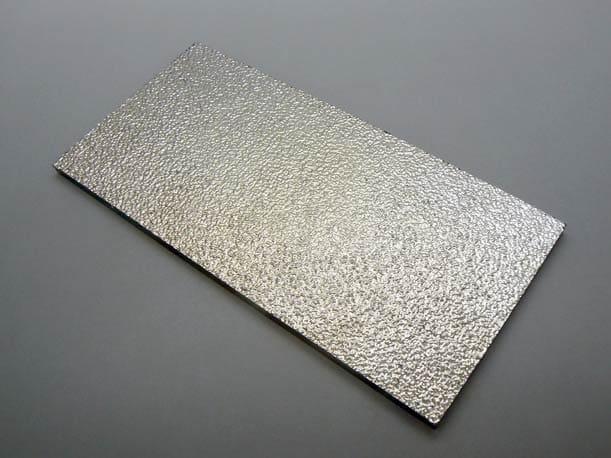
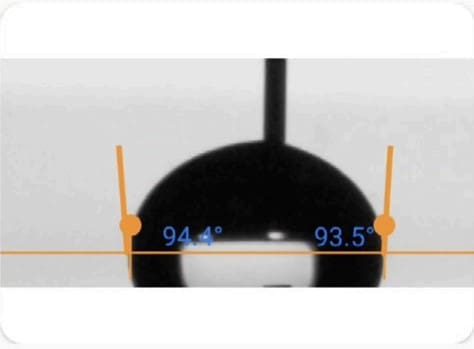
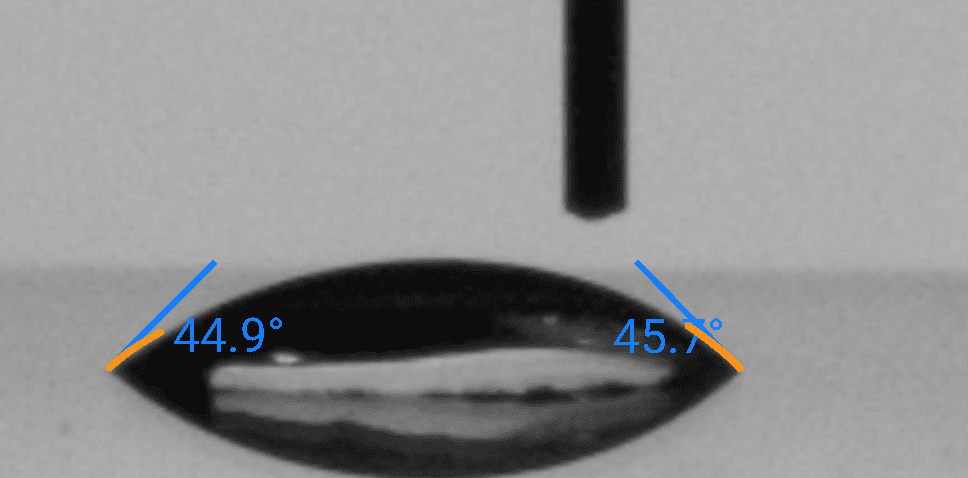
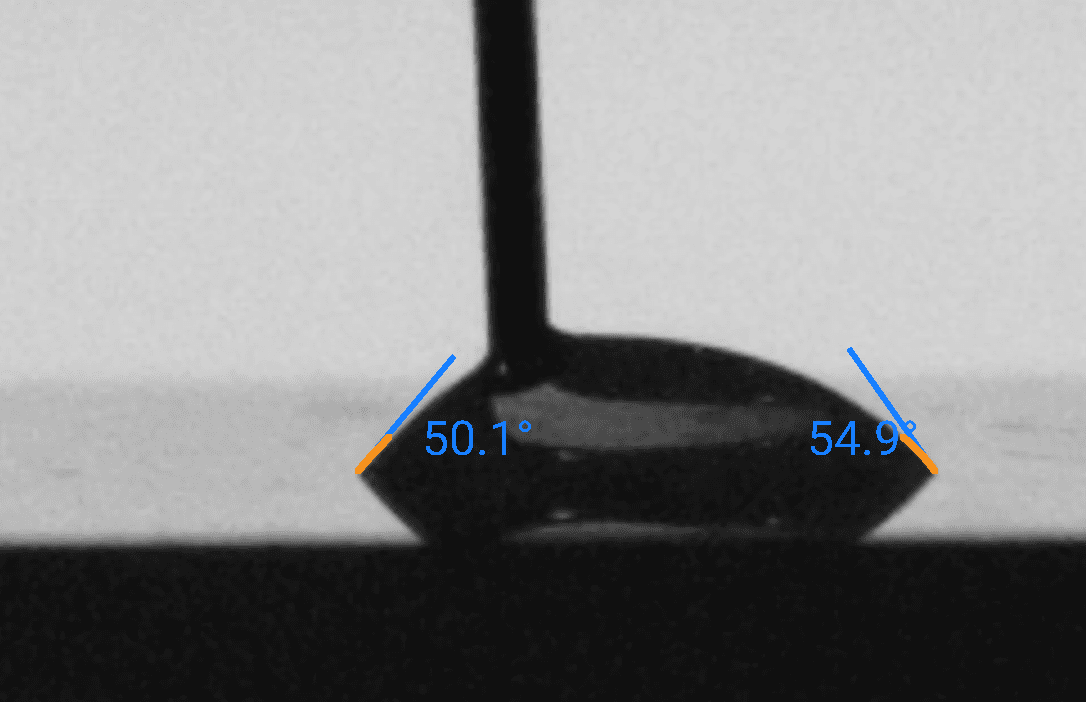
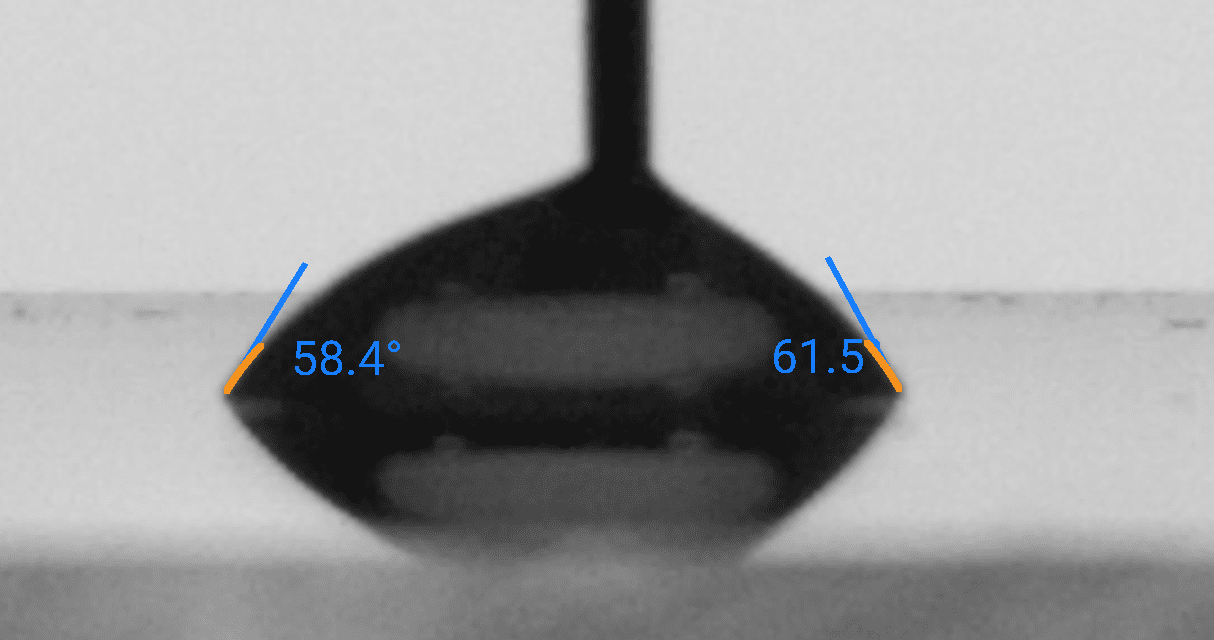
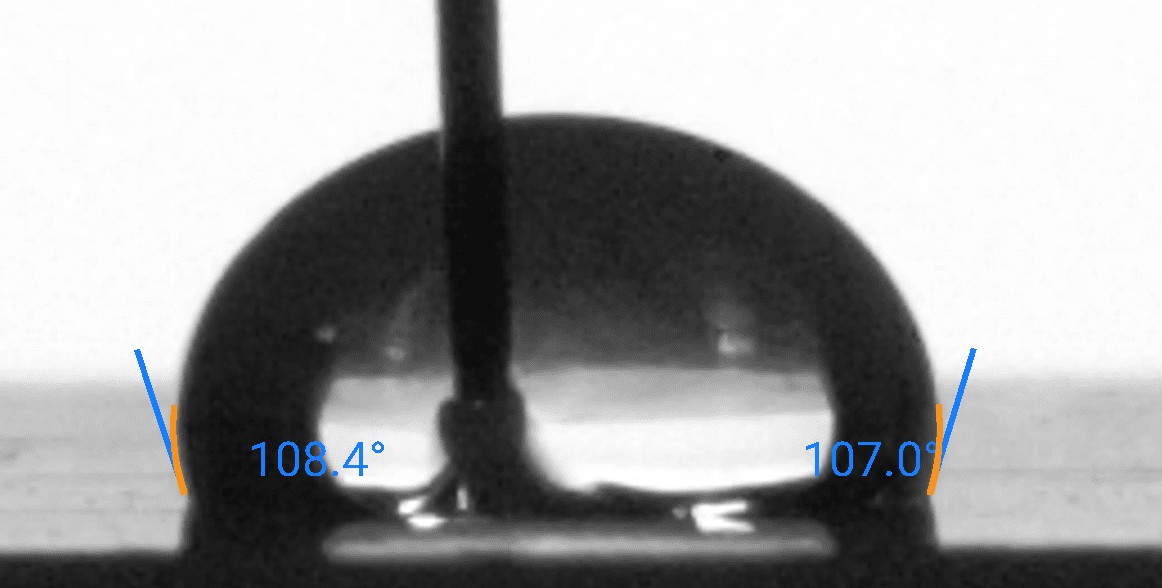
These reference measurements show how deionized water wets four standard substrates measured with the Droplet Lab Dropometer. Use them as visual and numerical benchmarks when you're checking your own sample preparation, treatments, and chemistry.

Full contact angle and surface energy datasets (including additional liquids and statistics) are available on our dataset hub.

Glass - DI Water
Glass - DI Water
Nylon - DI Water
Nylon - DI Water
PMMA - DI Water
PMMA - DI Water
Teflon - DI Water
Teflon - DI Water

The droplet images above are taken from the same benchmark series as our open dataset. For each substrate and probe liquid we report:

● Advancing and receding contact angles (and hysteresis)
● Derived surface energy (SFE) values based on multi-liquid measurements
● Measurement conditions, uncertainties, and sample preparation details

Comparing your own droplet shapes and angles against these references is a fast way to spot contamination, treatment drift, or unexpected changes in wettability.

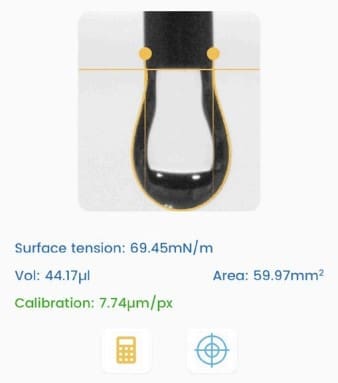
Capítulo 3: Medición de la tensión superficial

Esta propiedad mide la fuerza que actúa sobre la superficie de un líquido, con el objetivo de minimizar su superficie.

Medición de tensión superficial

Sample Image taken from Droplet Lab Tensiometer

Tensión superficial dinámica

La tensión superficial dinámica difiere de la tensión superficial estática, que se refiere a la energía superficial por unidad de área (o fuerza que actúa por unidad de longitud a lo largo del borde de una superficie líquida).

La tensión superficial estática caracteriza el estado de equilibrio de la interfaz líquida, mientras que la tensión superficial dinámica explica la cinética de los cambios en la interfaz. Estos cambios podrían implicar la presencia de tensioactivos, aditivos o variaciones en la temperatura, la presión y la composición en la interfaz.

Cuándo utilizar la medición dinámica de la tensión superficial

Dynamic surface tension is essential for processes that involve rapid changes at the liquid-gas or liquid-liquid interface, such as droplet and bubble formation, coalescence (change in surface area), the behavior of foams, and the drying of paints (change in composition, e.g., evaporation of solvent). It is measured by analyzing the shape of a hanging droplet over time.

La tensión superficial dinámica se aplica a diversas industrias, incluidas las cosméticas, los recubrimientos, los productos farmacéuticos, la pintura, los alimentos y las bebidas, y los procesos industriales, donde la comprensión y el control del comportamiento de las interfaces líquidas son esenciales para la calidad del producto y la eficiencia del proceso.

Aprenda cómo se realiza la medición de la tensión superficial en nuestro tensiómetro

Para una comprensión más completa de la medición de la energía superficial, lea nuestra medición de la tensión superficial: la guía definitiva

Capítulo 4: Medición de la energía superficial

La energía superficial se refiere a la energía requerida para crear una unidad de área de una nueva superficie.
231

Sample Image taken from Droplet Lab Tensiometer

Aprenda cómo se realiza la medición de la energía superficial en nuestro tensiómetro

Para una comprensión más completa de la medición de la energía superficial, lea nuestra medición de la energía superficial: la guía definitiva

For benchmark contact angle and surface energy values on glass, nylon, PMMA, and Teflon, see the Open Benchmark Data panel above or visit our Dataset Hub for full CSV downloads.

Capítulo 5: Medición del ángulo de deslizamiento

El ángulo de deslizamiento mide el ángulo en el que una película líquida se desliza sobre una superficie sólida. Se emplea comúnmente para evaluar la resistencia al deslizamiento de una superficie.

Ángulo de deslizamiento 1

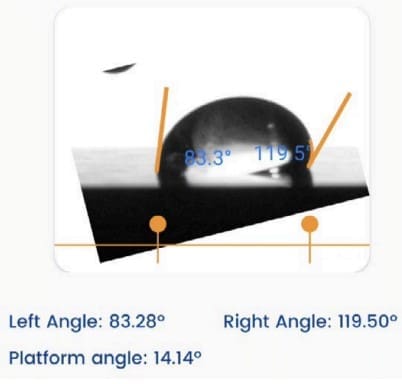
Sample Image taken from Droplet Lab Tensiometer

Aprenda cómo se realiza la medición del ángulo de deslizamiento en nuestro tensiómetro

Para una comprensión más completa de la medición del ángulo de deslizamiento, lea nuestra medición del ángulo de deslizamiento: la guía definitiva

Capítulo 6: Aplicaciones en el mundo real

Within the Chemicals industry, several case studies exemplify the advantages of conducting surface property measurements.

Dynamic-covalent fluorosurfactant system for stabilizing fluorinated-oil emulsions by forming an elastic interfacial film

The authors report a newly synthesized fluorosurfactant made by copolymerizing a fluoroacrylate with a boronic-acid-containing acrylamide to stabilize droplets of fluorinated oils. At the fluorinated oil/water interface, the copolymer can dynamically couple with diols or polyols present in the aqueous phase, forming an ultrathin elastic film that stiffens the interface. This interfacial rigidification suppresses droplet recoalescence and enables more robust droplet-based applications.

Role of the Droplet Lab Goniometer

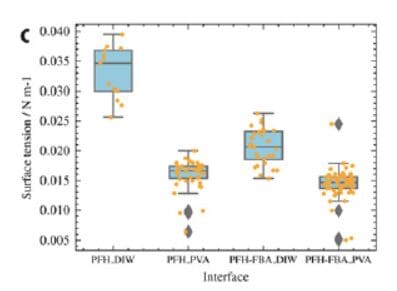
The Droplet Lab tensiometer was used in pendant-drop mode to quantify interfacial tension between perfluorohexane (PFH) and aqueous phases with/without additives. This measurement verified how the new fluorophilic boronic acid (FBA) copolymer and poly(vinyl) alcohol (PVA) each influence interfacial tension and supported the key conclusion that lasting emulsion stability requires the combined FBA–PVA interfacial assembly, not just tension reduction alone (methods: pendant-drop tensiometry; results summarized and visualized in Fig. 2b–c).

Key Findings

  • Interfacial-tension reduction is measurable but not sufficient by itself:
    • Adding FBA to PFH reduces PFH–water interfacial tension to ~20 mN/m (from ~30 mN/m without additives).
    • Adding PVA to water reduces it to ~17 mN/m.
    • The combined FBA-in-PFH + PVA-in-water yields a similar interfacial tension, but stable resistance to coalescence occurs only when both are present.
  • Mechanistic stabilization via an elastic interfacial film: dynamic boronic ester bonding between FBA (oil phase) and PVA (water phase) forms a solid-like elastic film, evidenced by transient wrinkling during droplet retraction (Fig. 2a).
  • Elasticity jump vs commercial control surfactant: interfacial rheology shows the FBA–PVA interface has a ~2-orders-of-magnitude higher complex shear modulus than interfaces stabilized with a commercial fluorosurfactant control (008-FluoroSurfactant) or PVA alone.

Enables complex, thermally reconfigurable emulsions: stable water-in-oil-in-water double emulsions with a hexane:PFH mixed oil shell can undergo temperature-triggered phase separation (around an UCST near 23 °C), reconfiguring into more complex morphologies (triple-emulsion structures) upon cooling.

Why It Matters

For chemical formulators working with fluorinated oils (often challenging to stabilize), this study shows that engineering interfacial mechanics (creating an elastic film via dynamic covalent coupling) can be more decisive than lowering interfacial tension alone. Practically, this supports surfactant system selection and spec-setting: pairing a fluorophilic surfactant with a complementary aqueous-phase polymer (diol/polyol functionality) can deliver robust anti-coalescence performance, enabling more reliable emulsions for microreactors, encapsulation, and responsive materials.

Method Snapshot

  • Sample/interface: PFH–water interfaces with/without FBA in PFH and/or PVA in water.
  • Droplet method: Pendant-drop tensiometry (Droplet Lab tensiometer; OpenDrop analysis).
  • Temperature: not explicitly stated for tensiometry (typical use suggests ambient conditions; only reportable as “not specified”).
  • Angle type: N/A (no contact-angle measurements reported).

Surface/interfacial tension outcomes: PFH–water ~30 mN/m (baseline), reduced to ~20 mN/m (with FBA) and ~17 mN/m (with PVA).

Data Note

Figure 2c contains the surface/interfacial tension measurements (boxplots) for PFH–water interfaces across four conditions (PFH/DIW, PFH/PVA–water, PFH+FBA/DIW, PFH+FBA/PVA–water), generated using the Droplet Lab tensiometer.

Figure

Citation (APA Format)

Wu, Z., Deveney, B. T., Werner, J. G., Aime, S., & Weitz, D. A. (2025). Fluorophilic boronic acid copolymer surfactant for stabilization of complex emulsion droplets with fluorinated oil. Lab on a Chip, 25, 2315–2319. https://doi.org/10.1039/d5lc00309a

View Publication →

Nanoparticle Dispersibility

In the dynamic and ever-evolving chemical industry, achieving a uniform dispersion of nanoparticles is a challenging task that often determines the effectiveness of a formulation. Imagine a scenario where nanoparticles, commonly used to enhance the performance or appearance of a product, tend to aggregate, leading to non-uniform distributions within the formulation. This aggregation not only reduces the product's efficacy but also poses challenges in the manufacturing process.

By precisely manipulating surface properties such as wettability and surface energy, nanoparticles can achieve a homogeneous dispersion throughout the formulation. This uniform dispersion is crucial for ensuring consistent product quality and performance. The benefits of this precise control go beyond achieving uniformity. Improved nanoparticle dispersibility enhances product stability, shelf life, and overall effectiveness, providing a significant competitive advantage in the market.

Nanoparticle Dispersibility

Adhesion Enhancement

In the field of coatings and adhesives, adhesion is critically important as it can significantly impact a product's effectiveness. Consider a situation where the bonding between a coating and its underlying substrate is suboptimal, leading to issues such as peeling, delamination, or reduced longevity. By accurately measuring contact angles and understanding the interactions at the interface between the coating and substrate, you can make informed decisions on modifying surface properties.

Enhanced adhesion is achieved by strategically adjusting the surface properties of coatings to increase compatibility with substrates. This not only improves the product's performance but also extends its lifespan, enhancing the durability and efficacy of products across various industries, including automotive, construction, and others that heavily rely on coatings and adhesives.

Adhesion Enhancement

Sustainable Chemical Production

A chemical company faces the challenge of transitioning to sustainable methodologies amid growing environmental concerns, stringent regulations, and shifting customer preferences towards eco-friendly products. To tackle this challenge, the company leverages surface science as a transformative tool.

Contact angle and surface tension measurements play a crucial role in this transition by providing precise insights into the surface properties of materials. These measurements help the company evaluate and optimize the wetting characteristics and interactions of raw materials, leading to the development of more efficient catalysts. By understanding and manipulating these surface properties, researchers can enhance catalyst efficiency, reduce waste, and lower energy consumption, aligning with sustainable production principles.

As a result, the company significantly reduces its environmental impact, surpasses regulatory requirements, and positions itself as a leader in environmentally responsible chemical manufacturing. This shift not only benefits the environment but also leads to cost savings, market expansion, and a strengthened brand image, as consumers increasingly favor products that adhere to sustainability standards.

Sustainable Chemical Production

Somos sus socios en la resolución de su negocio y tecnología Desafíos

Si está interesado en implementar estas u otras aplicaciones, póngase en contacto con nosotros.

Capítulo 7: Normas y directrices

In an industry where precision reigns supreme, how can Chemicals manufacturers ensure their products withstand scrutiny? The answer lies in standards and guidelines: the compass that guides them through the complex maze of quality and performance.

EN ISO 19403-3 (Part 3) — Paints and varnishes — Determination of surface tension using the pendant drop method

What it is

An optical method for determining the surface tension (γ) of paints, varnishes, and related liquid coating materials by fitting the pendant-drop profile using Young–Laplace shape analysis. Applicability can be restricted for liquids with non-Newtonian flow behaviour, so results must be interpreted within those limits.

When to use it

Incoming QC / batch-release trending

Incoming QC / batch-release trending
Use it to detect batch-to-batch γ drift in resins, solvent blends, additive packages, and finished formulations before application risk shows up on the line.

Troubleshooting wetting and leveling defects

Troubleshooting wetting and leveling defects
Use it when defects (e.g., craters/fisheyes, poor edge coverage, orange peel, intercoat wetting changes) suggest a wettability shift, additive drift, or contamination.

In-scope / Out-of-scope

In scope
  • Liquid coating materials (e.g., resins, solvents, additives, surfactant packages, and paint/varnish formulations) where pendant-drop profiling is feasible.
  • Surface tension of liquids (γ) determined from pendant-drop shape using Young–Laplace fitting.
  • Controlled-condition measurement suitable for repeatable QC trending (temperature defined; density input required for calculations).
  • Replicate-based reporting with fit/shape validity checks (e.g., axisymmetry and fit success).
Out of scope
  • Contact angle / solid-surface wettability measurements (use contact-angle standards instead).
  • Interfacial tension and polar/dispersive component determination (addressed in other parts/methods; only claim if explicitly supported and validated).
  • Alternative surface-tension methods (e.g., ring/plate/bubble-pressure approaches) not based on pendant-drop profile fitting.
  • Full rheology characterization (the method notes non-Newtonian limitations but does not replace rheology testing when flow behaviour drives instability).

Minimum you must report (checklist)

  • Standard revision used (explicitly cite the year/edition used by your quality system) and any deviations from your SOP.
  • Sample identity and history (material type, lot/batch, dilution if any, conditioning/aging time, filtration/degassing if used).
  • Test temperature (setpoint and how it was controlled/verified).
  • Liquid density value at test temperature and the source/method used to obtain it (required input for Young–Laplace analysis).
  • Instrument + pendant-drop setup (instrument model, needle/capillary type/ID, optical calibration/scale approach, and any key acquisition settings that affect shape).
  • Replicates and statistics (number of drops; report γ plus median/mean and spread such as SD or IQR).
  • Fit model and validity criteria (Young–Laplace fitting stated explicitly; axisymmetry requirement; fit-quality pass/fail rule and how failed fits were handled).
  • Result reporting basis (γ in mN/m; time point or stabilization rule after drop formation; any observed time-dependence or instability).

Note: ISO listings show a 2017 edition and a newer 2024 edition—use and cite the exact revision required by your QMS so trending remains comparable. Instruments (e.g., Dropometer) can execute pendant-drop imaging and Young–Laplace fitting with QC gating, but they do not replace the standard or your lab’s controlled protocol.

How to interpret results (guardrails)

  • Treat γ as a trend vs a retained control/baseline, not a universal pass/fail: define Green/Yellow/Red limits by correlating γ shifts to downstream outcomes (leveling, defect counts, spray appearance) for each material family.
  • Use replicate scatter as a diagnostic: unusually high spread or unstable drop profiles often indicate contamination, sample heterogeneity, or handling/cleaning issues—investigate before adjusting formulation.
  • Fit quality is a hard gate: if the drop is not axisymmetric or the Young–Laplace fit fails your acceptance criteria, the result is not valid—re-clean, re-sample, and re-run.
  • Be cautious with non-Newtonian/time-dependent liquids: if the profile evolves with time or repeatability is poor, interpret γ within the method’s limitations and confirm with complementary rheology and/or application tests.

Ahora te toca a ti

We hope this guide showed you how to apply surface science in the Chemicals industry.

Ahora nos gustaría entregárselo a usted:

Feel free to leave a comment below—we’d love to hear from you.

Preguntas frecuentes

Do we need a computer or mains power on the floor?

No—measurements run on your company phone; the app works offline.

Do we need a computer or mains power on the floor?

No—measurements run on your company phone; the app works offline. No—measurements run on your company phone; the app works offline. No—measurements run on your company phone; the app works offline.

Do we need a computer or mains power on the floor?

No—measurements run on your company phone; the app works offline. No—measurements run on your company phone; the app works offline. No—measurements run on your company phone; the app works offline.

Contesta

Su dirección de correo electrónico no será publicada. Los campos obligatorios están marcados *


Descargar Experimento