

Contenido
Contenido

Industry guide

Chemicals Industry: The Practical Guide to Surface Science (2026)

Last reviewed 15 min read

Escrito por
Dr. Amit Pratap Singh
PhD, Delhi University Post Doc - AIST Japan
Guest Author
leer más
alidad
Reviewed by
Dr. Alidad Amirfazli
Dr. Amirfazli, a leading expert in surface wetting and superhydrophobic coatings, has 250+ publications, edits Advances in Colloid and Interface Science, and has received multiple research awards.
Scientific Advisor & Co-founder
leer más
Written By

Dr. Amit Pratap Singh

Guest Author

PhD, Delhi University

Post Doc - AIST Japan

alidad
Reseña escrita por

Dr. Alidad Amirfazli

Scientific Advisor & Co-founder

Dr. Amirfazli, a leading expert in surface wetting and superhydrophobic coatings, has 250+ publications, edits Advances in Colloid and Interface Science, and has received multiple research awards.

This is a practical guide to surface science for teams working in the Chemicals industry.

In this guide: the four measurements that matter, where they decide yield in Chemicals, and the standards, use cases and studies behind them.

chemical

Executive summary

What it covers

How chemical R&D and QC teams use four measurements: surface and interfacial tension, contact angle, surface free energy and sliding angle. Each one is tied to a real formulation problem, a standard and a published client study.

Key insights

Lower interfacial tension alone does not make an emulsion stable. A Harvard study that measured interfacial tension on the Dropometer found stability also needed an elastic film at the interface. Dynamic surface tension matters wherever interfaces form fast, such as foams, sprays and drying films.

Business value

Surface measurements catch drift in surfactants, resins and solvent blends before it reaches a customer. One portable kit covers all four measurements, so a single lab can screen and release formulations without booking a shared benchtop instrument.

Standards to follow

EN ISO 19403-3 covers the surface tension of coating liquids by the pendant drop method. ASTM D1331 covers surface and interfacial tension of solutions by ring and plate methods. Other parts of ISO 19403 cover contact angle, dynamic contact angle and the tilting plate. Cite the edition your quality system uses.

Bottom line

Measure surface and interfacial tension while you formulate, and contact angle once the product meets a surface. Start with the measurement that matches your failure, then book a 15-minute consult about testing it on your own samples.

Where wetting decides yield

In chemical manufacturing, many quality problems start at an interface. A surfactant lot that lowers surface tension less than the last one gives poorer wetting downstream. An emulsion that separates in storage fails the customer, even when its composition passed release.

The Dropometer drop shape analysis kit measures contact angle, surface and interfacial tension, surface free energy and sliding angle with one portable setup. Its method was validated against a KRUSS DSA100E in two peer reviewed papers. If you are new to the terms, start with wettability.

Which measurement for which problem

A dot means the measurement is the main check for that problem.

ProblemContact angleSurface and interfacial tensionSurface energySliding angle
Self-Healing Elastomer Surface Characterization
PFAS-Free Reformulation & Repellency
Membrane Surface and Fouling Characterization
CMC Assessment Techniques for Surfactant Concentration
Emulsion Stability Mechanism
Foam Control And Foam Quality Tuning
Contact Angle and Surface Tension of Corrosive Liquids
Drilling and Fracturing Fluid Surfactant Screening
Drift Reduction Adjuvant Strategy for Pesticide Spray
Electrolyte Wetting Optimization And Additive Selection

The four measurements behind this guide

Not sure which test you need? Start with how to choose a wettability testing method.

Contact angle

The angle a liquid drop makes where it meets a solid, in degrees. A low angle means the liquid spreads; a high angle means it beads. Use static angles for quick checks, and advancing and receding angles on real, rough or patchy surfaces, where one static value can mislead.

Surface and interfacial tension

The force at a liquid surface that pulls it to the smallest area, in mN/m. The Dropometer measures it from the shape of a hanging (pendant) drop, and interfacial tension from a drop of one liquid inside another. Use static values for batch checks and dynamic values when interfaces form fast.

Surface energy

The energy needed to create new solid surface, in mJ/m². It is worked out from contact angles of two or more probe liquids. Use it before bonding, printing or coating to check that a surface is clean and treated enough.

Sliding angle

The tilt, in degrees, at which a drop starts to roll or slide off a surface. Use it for water and oil repellent surfaces, where a high contact angle alone does not show that drops will shed.

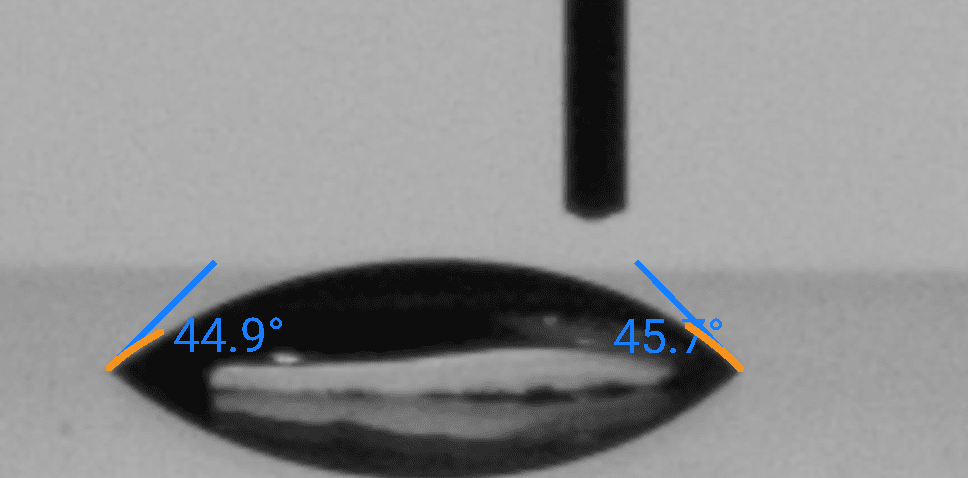
Glass - DI Water
Glass - DI Water
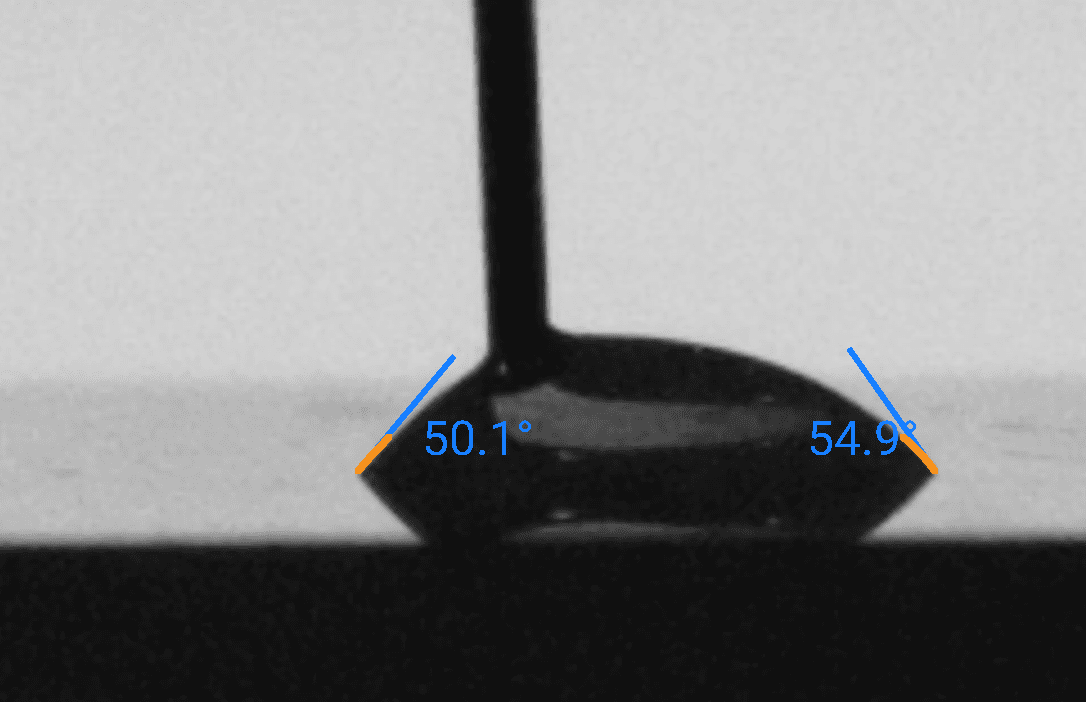
Nylon - DI Water
Nylon - DI Water
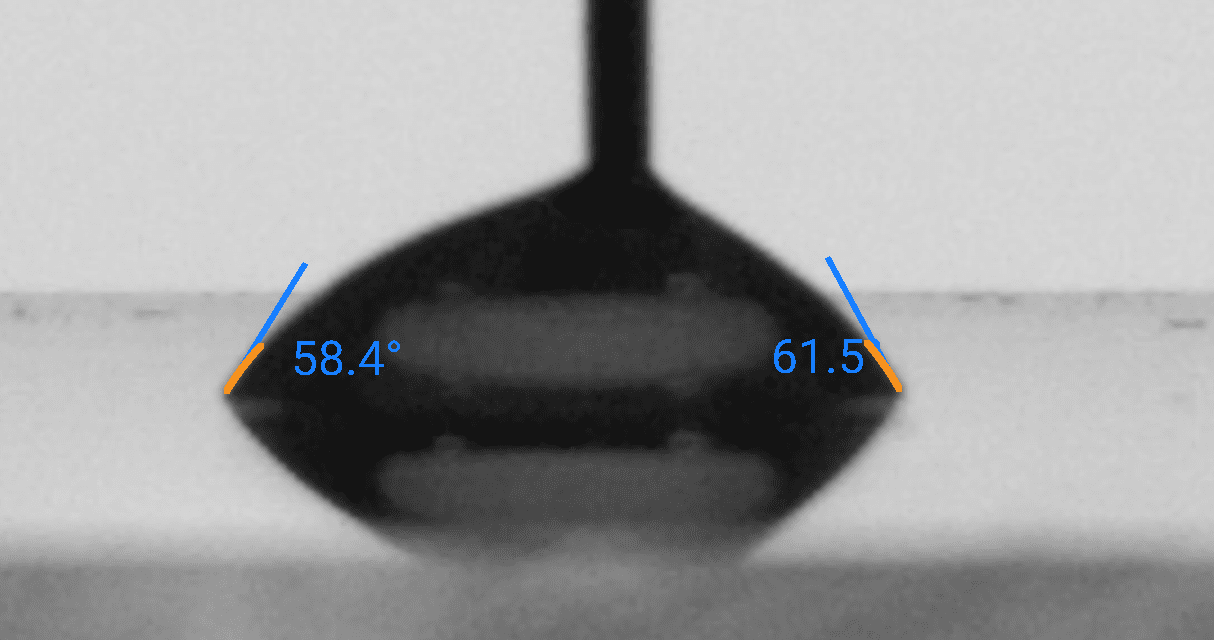
PMMA - DI Water
PMMA - DI Water
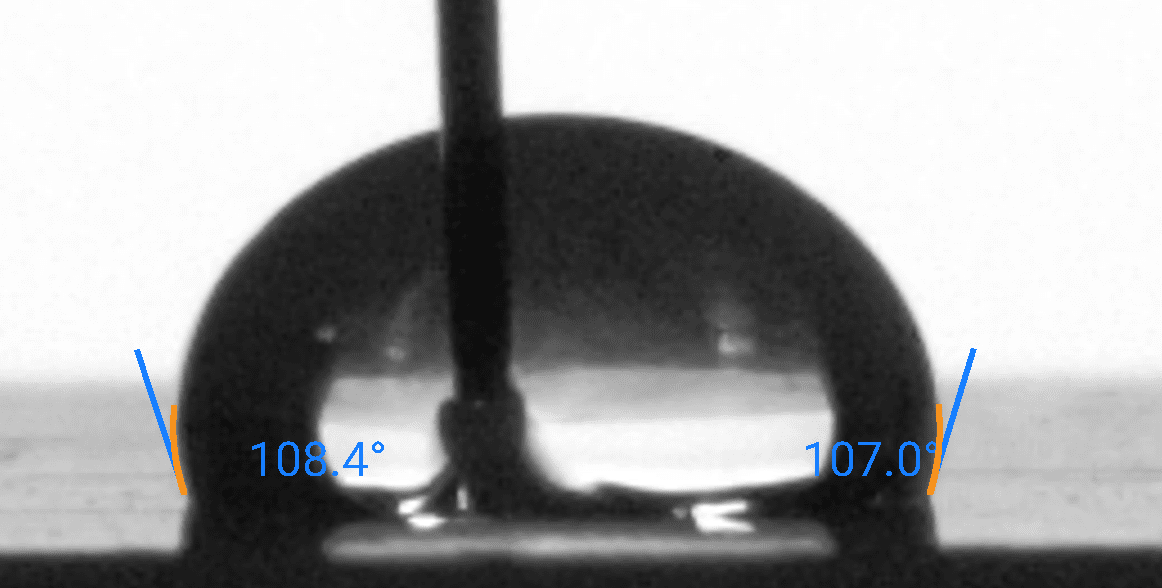
Teflon - DI Water
Teflon - DI Water

The droplet images above are taken from the same benchmark series as our open dataset. For each substrate and probe liquid we report:

● Advancing and receding contact angles (and hysteresis)
● Derived surface energy (SFE) values based on multi-liquid measurements
● Measurement conditions, uncertainties, and sample preparation details

Comparing your own droplet shapes and angles against these references is a fast way to spot contamination, treatment drift, or unexpected changes in wettability.

Case studies

Chemicals teams using the Dropometer.

Client citations

Published studies that measured with the Dropometer. Our analysis explains what was measured and how; the original paper is linked beside it.

  • Bio-based ski wax Prototype Development, Hydrophobicity, Hardness, Biodegradation And Glide Performance On Snow

    Researchers measured static contact angle and roll off of fluorine free ski waxes at minus 5 °C with a rented Dropometer, a model for PFAS free wax and coating screening.

  • Design and implementation of environment chamber for interfacial phenomenon processes

    A thesis built a temperature and humidity chamber and used Dropometer surface tension and contact angle of water to check it against known behaviour, for testing under process conditions.

  • Effect of Polymer Concentration on the Rheology and Surface Activity of Cationic Polymer and Anionic Surfactant Mixtures

    Pendant drop surface tension of a cationic cellulose polymer with sodium lauryl sulfate fell from 64.09 to 27.058 mN/m at 250 ppm, showing the complexes were more surface active.

  • Flow and clogging of capillary droplets

    Authors measured octane in water interfacial tension at about 10 mJ/m² on the Dropometer, which set the absolute scale for their models of droplets clogging narrow channels.

  • Fluorophilic boronic acid copolymer surfactant for stabilization of complex emulsion droplets with fluorinated oil

    Interfacial tension of perfluorohexane and water fell from about 30 to about 17 to 20 mN/m with additives, yet only the combined system gave lasting emulsion stability.

  • Glassy and Jammed Systems: Structures and Dynamics

    This thesis used Dropometer oil and water surface tension to normalise yield stress against volume fraction for silicone oil in water emulsions with different droplet sizes.

  • Influence of Added Surfactants on the Rheology and Surface Activity of Polymer Solutions

    Surface tension of four polymers with four surfactant types showed which pairs were more surface active than surfactant alone, and gave a CMC of 350 ppm for one pair.

  • Influence of Cellulose Nanocrystals and Surfactants on Catastrophic Phase Inversion and Stability of Emulsions

    Surface and interfacial tension showed SDS cut oil and water tension from 57.2 to 3.02 mN/m while nanocrystals barely lowered surface tension, helping explain emulsion phase inversion behaviour.

  • Influence of Surfactants on the Rheological Behavior of Nanocrystal Suspension

    Surface tension of cellulose nanocrystal suspensions with HTAB showed a break near 300 ppm that matched rheology changes, tracking surfactant moving onto the particle surfaces.

  • La reología encuentra distintas transiciones de vidrio y atasco en las emulsiones

    Authors measured TPM oil and water surface tension at 3 mN/m on the Dropometer and used it to scale yield stress and deformation energy in their emulsion rheology.

  • Steady Shear Rheology and Surface Activity of Polymer–Surfactant Mixtures

    Surface tension of two polymers with five surfactants, 12 readings each, ranked surfactant effectiveness and estimated aggregation points, with Amphosol the strongest tension reducer.

  • UV Responsive, Bottlebrush Structured Silicone Elastomers: Synthesis, Healing, and Application

    Water contact angle rose from 98.4° to 125° as fluorine spacer content increased, showing how graft chemistry tunes the wettability of new silicone elastomers.

  • Rheology of Cellulose Nanocrystal and Fumed Silica Suspensions: Influence of Ionic Surfactants

    Surface tension located HTAB break points near 229 to 352 ppm in nanocrystal and fumed silica suspensions, helping explain how ionic surfactants change particle network rheology.

  • Zein Protein Nanoparticles: Fabrication and Rheology of Their Dispersions in Polysaccharides

    Surface tension showed zein nanoparticles lower tension in carboxymethyl cellulose and xanthan solutions, levelling off beyond 3 wt%, useful for makers of particle stabilised dispersions.

Industry standards

Standards that describe these measurements for Chemicals. Our page explains how the Dropometer fits each one; the standard itself is sold by its publisher.

  • ASTM D1331

    Covers surface and interfacial tension of paints, solvents and surfactant solutions by ring and plate; the Dropometer reaches both by pendant drop, using the optional cuvette for interfacial tension.

  • ASTM D1417

    Latex makers use its surface tension test to track surfactant at the latex surface; pendant drop gives that value instead of ring or plate, not the other eleven tests.

  • ASTM D3825

    Withdrawn in 2016 but still cited for fast forming interfaces in sprays and foams; pendant drop follows surface tension from about 0.1 s of surface age, not milliseconds.

  • ASTM D8597

    Describes sessile drop contact angle on coatings, substrates and pigments with portable goniometers, so chemical suppliers can check how their products wet a surface outside the central lab.

  • EN 14210

    Sets stirrup or ring measurement of tension between a surfactant solution and an immiscible liquid, 4 to 50 mN/m; the Dropometer uses pendant drop with the optional cuvette.

  • EN 14370

    Describes static surface tension of surfactant solutions against air by plate, stirrup or ring; pendant drop gives the same quantity for producers checking how far each lot lowers tension.

  • EN ISO 19403-3

    Describes surface tension of coating liquids by the pendant drop method, the drop shape analysis the Dropometer runs, so resin and additive makers can test liquids before application.

  • EN ISO 19403-6

    Describes advancing and receding contact angles measured as a sessile drop grows and shrinks, showing how a coating or treated surface holds or sheds liquid.

  • ISO 1409

    Sets ring or plate surface tension for polymer dispersions and rubber latices at 23 °C; pendant drop gives an alternative value for dispersion makers tracking surfactant level between batches.

  • ISO 19403-2: Paints and Varnishes

    Describes working out surface free energy of paints and substrates from contact angles of several liquids; measure on the Dropometer, then run OWRK in the free surface energy calculator.

  • ISO 19403-7:2024

    Describes the tilt angle at which a drop starts to move on a coated specimen, a direct number for repellent and easy clean finishes such as PFAS free replacements.

  • ISO 4311

    Finds the critical micelle concentration from surface tension across a dilution series; a pendant drop series gives the CMC as an alternative to the plate, stirrup or ring it names.

  • ISO 6889

    Measures tension between a surfactant solution and an immiscible liquid with a stirrup or ring; the Dropometer measures interfacial tension by pendant drop with the optional cuvette instead.

Frequently asked questions

Which surface measurement should a chemicals lab start with?

Start with the failure you are trying to prevent. Use surface tension for surfactants, inks and coating liquids, and interfacial tension for emulsions. Use contact angle and surface free energy when a coating or adhesive must wet a solid. Use sliding angle for repellent surfaces. Our surface tension y contact angle guides explain each method.

What is the difference between static and dynamic surface tension?

Static surface tension is the value once the interface has settled. Dynamic surface tension tracks how it changes in the first seconds after a new surface forms, while surfactant molecules move to it. Foams, sprays, printing and drying films all depend on the dynamic value. The pendant drop method measures both by imaging the same drop over time. See dynamic surface tension.

Can the Dropometer measure interfacial tension between two liquids?

Yes. A drop of one liquid is formed inside the second liquid, and the drop shape gives the interfacial tension. You need the density of both liquids at the test temperature. A Harvard team used this pendant drop mode to measure a fluorinated oil and water interface in a published emulsion study.

How do I find the critical micelle concentration of a surfactant?

Measure surface tension across a dilution series, from well below to well above the expected CMC. Plot surface tension against the log of concentration. The CMC is where the falling line meets the flat plateau. Our CMC use case and the ISO 4311 page cover the details.

Which standards apply to surface tension in the chemical industry?

EN ISO 19403-3 covers coating liquids by the pendant drop method, which is the method the Dropometer uses. ASTM D1331, ISO 1409 y ISO 6889 describe other methods, such as the ring and the plate. The Dropometer does not run those methods, so check which method your specification names before you compare results.

Can I measure acids, ionic liquids or other corrosive liquids?

Yes, with care. Choose a needle and syringe that the liquid will not attack, and clean the stage after each test. Our page on contact angle and surface tension of corrosive liquids covers the setup. Tell us the liquid when you book a demo and we will suggest the right parts.

How accurate is the Dropometer?

The drop shape method was validated against a KRUSS DSA100E in two peer reviewed papers, one in Review of Scientific Instruments and one in Colloids and Surfaces A. Published contact angle accuracy is 0.35 degrees. Automatic edge and baseline detection gives the same reading from the same image. See our validation papers.

Do published chemistry studies use the Dropometer?

Yes. Chemistry groups have used it for surfactant, polymer and emulsion research, including studies of polymer and surfactant mixtures y glass and jamming transitions in emulsions. Browse every study on our client citations page.

See it on samples like yours

Book a 15 minute consult and we will show the Dropometer measuring the kind of surface or liquid your team works with.

Further resources

Every page and paper referenced in this guide, grouped by type.

Case studies6

Further resources29