





Contenido

Farmacéutico Industria
The Practical Guide to Surface Science (2026)

?s=100&d=m
Escrito por
No biography added yet.
leer más
?s=100&d=m
Reviewed by
N/A
No biography added yet.
leer más
?s=100&d=m
Written By

No biography added yet.

?s=100&d=m
Reseña escrita por

N/A N/A

No biography added yet.

This is a practical guide to Surface Science for researchers working in the Pharmaceutical Industry.

En esta nueva guía aprenderás todo sobre:

  • Principios cruciales de la ciencia de superficies
  • The significance of surface science measurements for the Pharmaceutical industry
  • Normas y directrices ASTM aplicables

Vamos a sumergirnos en ello.

Pharmaceutical Products

Executive Summary

What it covers: A practical, pharma-focused guide to applying surface science—contact angle (static and dynamic), surface/interfacial tension (including dynamic), surface energy, and sliding angle—to understand and control powders, liquids, coatings, and interfaces. It also includes benchmark reference data, real-world pharma case studies, and a reporting framework for repeatable measurements.
Key insights: Real pharmaceutical surfaces rarely have a single “true” contact angle; advancing/receding angles and hysteresis often tell you more than a one-off static value, especially on rough, heterogeneous, or porous substrates. Young–Laplace fitting tends to be more consistent for axisymmetric drops, while polynomial fitting is more flexible for non-axisymmetric drops; dynamic surface tension is the right tool when interfaces evolve quickly (e.g., during droplet/bubble formation, foams, and drying).
Business value: Turns wetting and interfacial behavior into measurable, trendable attributes that support faster formulation down-selection, smoother tech transfer, and more defensible investigations when dissolution, coating quality, or process performance drifts. In practice, these measurements can link physicochemical metrics to outcomes like vesicle yield, oral dissolution/bioavailability, cleanability/cross-contamination risk, patch bonding consistency, and inhalable aerosol performance.
Standards to follow: Align wetting characterization with USP ⟨1243⟩, Wetting Properties of Pharmaceutical Systems (Proposed General Chapter; PF 49(5)), emphasizing fixed-timestamp contact angle reporting, controlled temperature (and RH where relevant), and clear traceability (instrument/software/SOP/operator). Follow the chapter’s guardrails: use product-family-calibrated targets (not universal limits), report replicates + stats and explicit reject/re-run rules, and treat data as GMP/audit-ready only when captured under your site’s validated systems and procedures.
Bottom line: This is a standards-minded playbook for choosing the right surface measurement, running it in a controlled way, and interpreting it with the right guardrails, so wetting and interfacial effects stop being “mystery variables” and become actionable controls for formulation, manufacturing, and QC trending. It helps pharma teams move from subjective observations to comparable numbers that support better decisions and more robust products.

Capítulo 1: Introducción

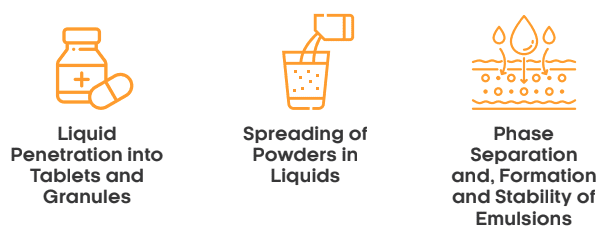
The pharmaceutical industry divides into major segments, including generic drugs, over-the-counter (OTC) medicines, bulk drugs, vaccines, contract research and manufacturing (CRO and CMO), biosimilars, and biologics. Characterizing pharmaceutical powders involves understanding surface properties, which play an important role in processes like liquid penetration into tablets and granules, the spreading of powders in liquids, phase separation, and the formation and stability of emulsions. Additionally, understanding processes such as adsorption, surface tension, and friction at phase interfaces is essential to achieving optimal conditions in pharmaceutics.


Farmacéutico

We use the following surface properties to understand the behavior of Pharmaceutical products and improve their quality.

Capítulo 2: Medición del ángulo de contacto

El ángulo de contacto cuantifica la humectabilidad de una superficie representando el ángulo entre la superficie de un líquido y una superficie sólida.
Investigación de Dropletlab

Sample Image taken from Droplet Lab Tensiometer.

Joven – Método Laplace

Método polinómico

Ángulo de contacto dinámico

Ideally, when we place a drop on a solid surface, a unique angle exists between the liquid and the solid surface. We can calculate the value of this ideal contact angle (the so-called Young’s contact angle) using Young’s equation. In practice, due to surface geometry, roughness, heterogeneity, contamination, and deformation, the contact angle value on a surface is not necessarily a single consistent value but rather falls within a range. The upper and lower limits of this range are known as the advancing and receding contact angles, respectively. The values of advancing and receding contact angles for a solid surface are highly sensitive to many parameters, such as temperature, humidity, homogeneity, and minor contamination of the surface and liquid. For example, the advancing and receding contact angles of a surface can differ at different locations.

Ángulo de contacto dinámico frente a ángulo de contacto estático

Las superficies y los recubrimientos prácticos muestran naturalmente histéresis de ángulo de contacto, lo que indica un rango de valores de equilibrio. Cuando medimos ángulos de contacto estáticos, obtenemos un solo valor dentro de este rango. Confiar únicamente en mediciones estáticas plantea problemas, como una repetibilidad deficiente y una evaluación incompleta de la superficie con respecto a la adherencia, la limpieza, la rugosidad y la homogeneidad.

In practical applications, we need to understand how easily a liquid spreads (advancing angle) and how easily it is removed (receding angle), such as in painting and cleaning. Measuring advancing and receding angles offers a holistic view of liquid-solid interaction, unlike static measurements, which yield an arbitrary value within the range.

Esta información es crucial para las superficies del mundo real con variaciones, rugosidad y dinámica, lo que ayuda a industrias como la cosmética, la ciencia de los materiales y la biotecnología a diseñar superficies efectivas y optimizar los procesos.

Aprenda cómo se realiza la medición del ángulo de contacto en nuestro tensiómetro

Para una comprensión más completa de la medición del ángulo de contacto, lea nuestra medición del ángulo de contacto: la guía definitiva

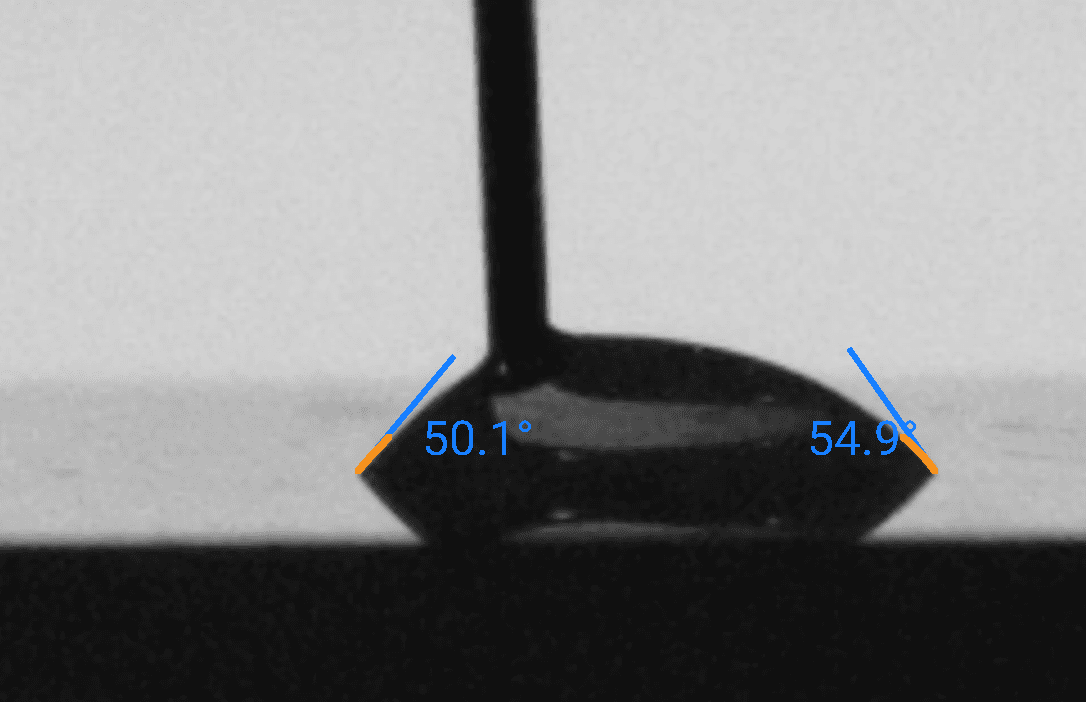
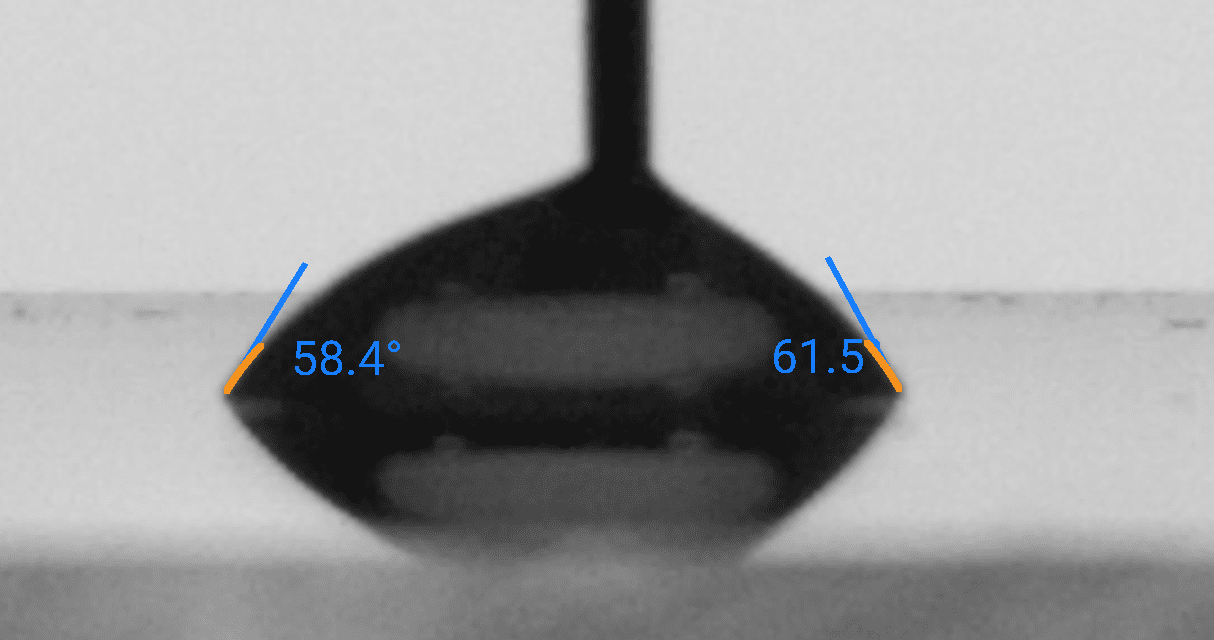
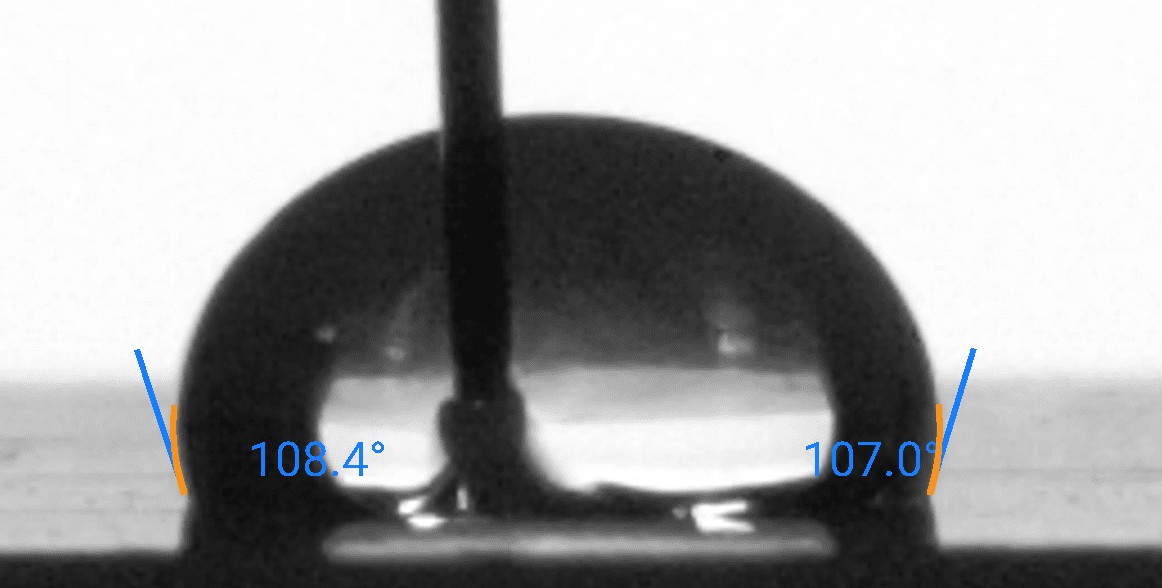
Open Benchmark Data: Contact Angle & Surface Energy

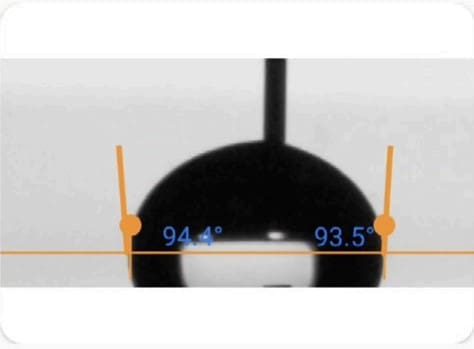
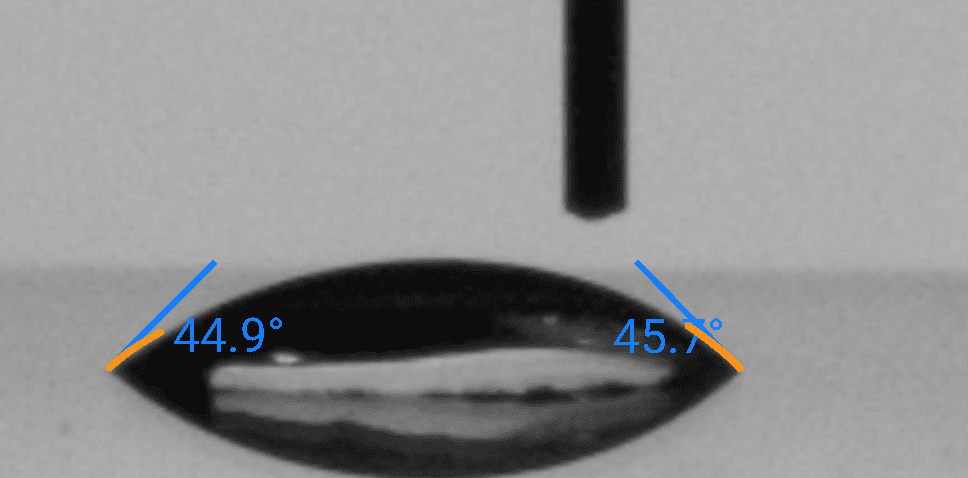
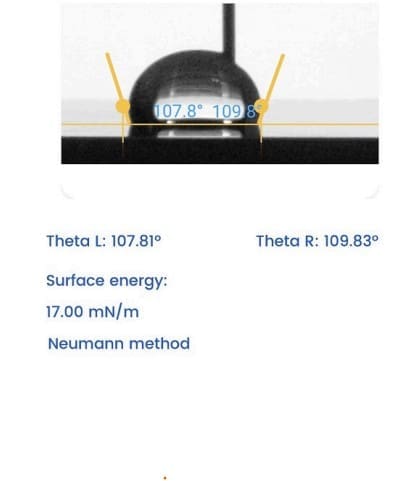
These reference measurements show how deionized water wets four standard substrates measured with the Droplet Lab Dropometer. Use them as visual and numerical benchmarks when you're checking your own sample preparation, treatments, and chemistry.

Full contact angle and surface energy datasets (including additional liquids and statistics) are available on our dataset hub.

Glass - DI Water
Glass - DI Water
Nylon - DI Water
Nylon - DI Water
PMMA - DI Water
PMMA - DI Water
Teflon - DI Water
Teflon - DI Water

The droplet images above are taken from the same benchmark series as our open dataset. For each substrate and probe liquid we report:

● Advancing and receding contact angles (and hysteresis)
● Derived surface energy (SFE) values based on multi-liquid measurements
● Measurement conditions, uncertainties, and sample preparation details

Comparing your own droplet shapes and angles against these references is a fast way to spot contamination, treatment drift, or unexpected changes in wettability.

Capítulo 3: Medición de la tensión superficial

Esta propiedad mide la fuerza que actúa sobre la superficie de un líquido, con el objetivo de minimizar su superficie.

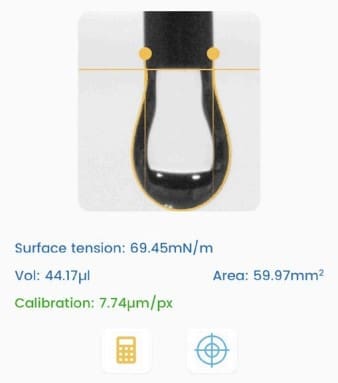
Medición de tensión superficial

Sample Image taken from Droplet Lab Tensiometer

Tensión superficial dinámica

La tensión superficial dinámica difiere de la tensión superficial estática, que se refiere a la energía superficial por unidad de área (o fuerza que actúa por unidad de longitud a lo largo del borde de una superficie líquida).

La tensión superficial estática caracteriza el estado de equilibrio de la interfaz líquida, mientras que la tensión superficial dinámica explica la cinética de los cambios en la interfaz. Estos cambios podrían implicar la presencia de tensioactivos, aditivos o variaciones en la temperatura, la presión y la composición en la interfaz.

Cuándo utilizar la medición dinámica de la tensión superficial

Dynamic surface tension is essential for processes that involve rapid changes at the liquid-gas or liquid-liquid interface, such as droplet and bubble formation, coalescence (change in surface area), the behavior of foams, and the drying of paints (change in composition, e.g., evaporation of solvent). It is measured by analyzing the shape of a hanging droplet over time.

La tensión superficial dinámica se aplica a diversas industrias, incluidas las cosméticas, los recubrimientos, los productos farmacéuticos, la pintura, los alimentos y las bebidas, y los procesos industriales, donde la comprensión y el control del comportamiento de las interfaces líquidas son esenciales para la calidad del producto y la eficiencia del proceso.

Aprenda cómo se realiza la medición de la tensión superficial en nuestro tensiómetro

Para una comprensión más completa de la medición de la energía superficial, lea nuestra medición de la tensión superficial: la guía definitiva

Capítulo 4: Medición de la energía superficial

La energía superficial se refiere a la energía requerida para crear una unidad de área de una nueva superficie.
231

Sample Image taken from Droplet Lab Tensiometer

Aprenda cómo se realiza la medición de la energía superficial en nuestro tensiómetro

Para una comprensión más completa de la medición de la energía superficial, lea nuestra medición de la energía superficial: la guía definitiva

For benchmark contact angle and surface energy values on glass, nylon, PMMA, and Teflon, see the Open Benchmark Data panel above or visit our Dataset Hub for full CSV downloads.

Capítulo 5: Medición del ángulo de deslizamiento

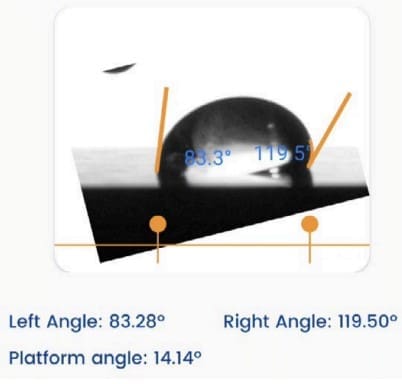
El ángulo de deslizamiento mide el ángulo en el que una película líquida se desliza sobre una superficie sólida. Se emplea comúnmente para evaluar la resistencia al deslizamiento de una superficie.

Ángulo de deslizamiento 1

Sample Image taken from Droplet Lab Tensiometer

Aprenda cómo se realiza la medición del ángulo de deslizamiento en nuestro tensiómetro

Para una comprensión más completa de la medición del ángulo de deslizamiento, lea nuestra medición del ángulo de deslizamiento: la guía definitiva

Capítulo 6: Aplicaciones en el mundo real

Within the Pharmaceutical industry, several case studies exemplify the advantages of conducting surface property measurements.

Pendant-Drop Interfacial Tension as a Formulation Screen for Scalable Lipid Vesicle Drug-Delivery Systems

The paper addresses a common pharmaceutical delivery challenge: therapeutic cargos vary widely, and delivery systems often require tuning to achieve robust performance. The authors present nanoscale lipid vesicles engineered with asymmetric leaflet composition and demonstrate that these vesicles can support delivery of nucleic-acid and protein payload classes in cellular models. A key formulation insight is established by linking interfacial properties of lipid-in-oil systems to vesicle formation outcomes, positioning interfacial tension as a measurable handle relevant to formulation selection and manufacturing robustness.

Role of the Droplet Lab Goniometer

Droplet Lab is used for pendant-drop tensiometry to quantify mineral oil / aqueous PBS interfacial tension for different lipid-containing oil formulations. These values are then interpreted against vesicle formation yield trends, making the Droplet Lab measurement a formulation-screening metric rather than a purely descriptive material property.

What this enables for pharma teams:

  • Objective comparison of lipid formulation “interfacial activity” (how strongly a lipid reduces oil/water interfacial tension)

A quantitative bridge from physicochemical measurement → process outcome (yield), supporting earlier-stage down-selection and comparability thinking.


Key Findings

  • Interfacial tension differs strongly across lipid chemistries in the oil/buffer system (Fig. 3c), demonstrating meaningful separation between candidates by a single quantitative metric.
  • The study reports a correlation between lower interfacial tension and higher vesicle yield, implying interfacial tension can act as an early indicator of formation efficiency.
  • Reported interfacial-tension values span a broad range (e.g., ~61.5 ± 3.5 mN/m for one lipid condition vs markedly lower values for others), providing a practical “screening window” for formulation differentiation.
  • Yield is assessed via fluorescence-linked quantification and is shown to vary substantially by lipid selection, reinforcing the need for formulation screening metrics beyond composition alone.

Why It Matters

In pharmaceutical development, delivery platforms succeed or fail not only on biological performance but on manufacturability, reproducibility, and change control. This paper highlights interfacial tension (measured by pendant drop) as a pragmatic, fast, and quantitative formulation attribute that correlates with formation yield—making it useful for formulation down-selection, comparability assessments, and QC-oriented specifications tied to interface-driven process behavior rather than trial-and-error alone.

Method Snapshot

Measurement mode: pendant-drop tensiometry (Droplet Lab) at an oil–aqueous buffer interface, with interfacial tension obtained by Young–Laplace shape fitting. Temperature is not explicitly stated in the pendant-drop description.

Data Note

Figure 3c: shows the interfacial tension results for water/mineral-oil systems with different lipids (caption notes Mean ± SD, n=3), providing the paper’s core Droplet Lab measurement dataset used to support the yield correlation.

Figure

Citation (APA Format)

Yang, C., Menge, J., Zhvania, N., Yu, M., Yang, H., Chen, D., Zheng, Z., Weitz, D. A., & Jahnke, K. (2025). Engineering asymmetric nanoscale vesicles for mRNA and protein delivery to cells. Advanced Functional Materials, 35, 2505738. https://doi.org/10.1002/adfm.202505738

View Publication →

Developing a New Oral Drug Formulation

Consider a scenario where a pharmaceutical company develops a new oral drug formulation. The drug's success depends on its ability to dissolve quickly and be absorbed by the body. By measuring the wetting angle of the drug solution on various excipient surfaces, such as the tablet matrix and coating materials, the company can identify which materials promote optimal wetting and dissolution. A lower contact angle indicates better wetting and faster dissolution, leading to improved bioavailability and therapeutic efficacy.

Developing a New Oral Drug Formulation

Preventing Contamination in Manufacturing

In pharmaceutical manufacturing, ensuring the cleanliness of equipment surfaces is crucial to preventing contamination and maintaining product quality. By measuring the sliding angle of liquids used in manufacturing, the company can identify surfaces that are less likely to allow liquids to adhere. This helps design equipment surfaces that are easy to clean and resistant to liquid adhesion, reducing the risk of cross-contamination and ensuring the production of safe and consistent pharmaceutical products.

Preventing Contamination in Manufacturing

Compatibility in Drug Delivery Systems

Consider a pharmaceutical company developing a transdermal patch for efficient drug delivery. The patch consists of a drug reservoir and an adhesive layer, both essential for optimal drug release and secure skin adhesion. However, the company discovered a discrepancy in the surface energies of these two materials. This insight prompted further investigation into potential causes, such as poor drug adhesion or inconsistent drug delivery. The company meticulously measured the surface energy of both the drug reservoir and the adhesive material, ensuring that these components have matching surface energies for proper bonding and consistent drug release.

Compatibility in Drug Delivery Systems

Optimizing Inhalable Medications

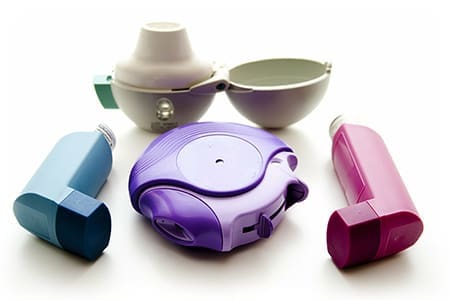
Consider a pharmaceutical company developing inhalable medications for respiratory conditions. The effectiveness of these medications relies on producing aerosol droplets of a precise size to effectively reach the lungs. By measuring the surface tension of the liquid formulation used in the aerosol, the company can optimize the spray characteristics to achieve the desired droplet size and uniformity. This process ensures the medication is delivered directly to the target site within the lungs, maximizing its therapeutic effect.

Optimizing Inhalable Medications

Somos sus socios en la resolución de su negocio y tecnología Desafíos

Si está interesado en implementar estas u otras aplicaciones, póngase en contacto con nosotros.

Capítulo 7: Normas y directrices

In an industry where precision reigns supreme, how can Pharmaceutical manufacturers ensure their products withstand scrutiny? The answer lies in standards and guidelines: the compass that guides them through the complex maze of quality and performance.

USP ⟨1243⟩ — Wetting Properties of Pharmaceutical Systems (Proposed General Chapter; PF 49(5))

What it is

A proposed USP general chapter that provides a standardized framework for characterizing wetting-related properties of pharmaceutical systems—most commonly through contact angle–based wettability assessment (solids) and surface/interfacial tension measurement techniques (liquids), along with discussion of influencing factors and related concepts (e.g., surface free energy).

When to use it

Formulation development / optimization

Compare excipient or surfactant options using contact angle and/or γ–log C behavior.

Tech transfer

Replace “looks OK” assessments with numeric, operator-comparable wetting metrics (defined timestamp for θ; defined temperature for γ).

Manufacturing / investigations

When you see batch-to-batch drift in disintegration/dissolution or coating appearance/uniformity and suspect wetting-related causes.

QC trending

Establish baseline and monitor drift in solid-side wettability and liquid-side spreading capability over time.

In-scope / Out-of-scope

In scope
  • Solids Wettability characterization via contact angle (with explicit definition of when the angle is read). Optional use of advancing/receding angles only when repeatable on the substrate.
  • Liquids Surface tension and (when relevant) interfacial tension measurement techniques and factors influencing results.
  • Method context Recognizing/controlling factors that influence measurements (surface heterogeneity, porosity/absorption, temperature, etc.).
Out of scope
  • Universal numeric limits (e.g., “θ must be < X° for all tablets”) — wetting targets must be product-/family-calibrated against performance outcomes.
  • Replacing compendial performance tests Wetting data supports understanding and control; it does not replace dissolution/disintegration or coating quality requirements.
  • Forcing unstable metrics If receding angle/hysteresis is not repeatable on rough/porous surfaces, don’t treat it as mandatory evidence.
  • Data-system compliance by default Instrument outputs are only “GMP records” when integrated under your site’s validated controls and procedures.

Minimum you must report (checklist)

  • Sample + context: sample ID (lot/product family), sample type (tablet/compact/coating vs solution/media), and any conditioning/handling (e.g., equilibration) plus the measurement map (faces/regions).
  • Test conditions: temperature (and RH if relevant) at time of test.
  • Traceability: instrument + software version, analysis model/fit method, and operator/SOP identifier.
  • Replicates + stats: n for each metric and the statistic you standardize on (e.g., median + IQR or mean + SD).
  • Solids (contact angle): probe liquid + droplet volume, θ @ fixed timestamp (and any secondary timepoint), spot-to-spot variability (IQR/SD), optional Δθ(t1→t2), and optional θₐ/θᵣ/hysteresis only if repeatable.
  • Liquids (surface/interfacial tension): method geometry (e.g., pendant drop), temperature setpoint, density inputs (and source), γ/IFT result (n + stats), pendant-drop fit/QC acceptance criteria; if reporting CMC, include concentration-series design and breakpoint/estimation method.
  • Data integrity: explicit reject/re-run rules (e.g., failed fit QC, unstable baseline/edge, absorption collapse before timestamp) and system suitability controls (reference tablet + reference liquid with run frequency and acceptance/trending limits).

Dropometer supports wetting characterization aligned with USP ⟨1243⟩ by producing standardized, timestamped θ (solids) and γ/IFT (liquids) with settings captured per run. Whether those records are GMP/audit-ready depends on your site’s validated systems, SOPs, and controls.

How to interpret results (guardrails)

  • Never compare solid θ without matching timestamp + conditioning; porous/absorbing surfaces can change rapidly, so fixed-time θ (and/or Δθ) is the defensible basis.
  • Use median θ @ t plus variability (IQR/SD) to separate “surface wettability shift” from “surface heterogeneity shift,” then confirm significance against your product-family correlation to outcomes.
  • Treat θₐ/θᵣ/hysteresis as optional diagnostics only when the substrate yields stable, repeatable values, don’t force it on rough/absorbing tablets.
  • Interpret γ/IFT primarily as a controlled trend metric (same temperature, same formulation window), and only trust changes when pendant-drop fit QC and inputs (temperature/density) are under control.

Ahora te toca a ti

We hope this guide showed you how to apply surface science in the Pharmaceutical industry.

Ahora nos gustaría entregárselo a usted:

Feel free to leave a comment below—we’d love to hear from you.

Contesta

Su dirección de correo electrónico no será publicada. Los campos obligatorios están marcados *