


Contenido

Contact angle goniometer buyer's guide

Best Contact Angle Goniometer for Teaching & Academic Labs

A teaching instrument is judged on how many students get a sensible result in one lab session, at a price that covers a whole class. This guide ranks three options, shows every weight and score, and says when to buy a research kit instead.

Scored 1 to 5 on 11 weighted criteria. Prices and specifications checked 23 October 2026.

Last reviewed 2026-10-23

Abhimanyu Photo
Escrito por
Abhimanyu Bhandankar
Holds an MBA from Schulich School of Business and a BE in IT. He joined Droplet Lab in July 2019 and now leads sales and marketing.
CEO at Droplet Lab
leer más
Gurdeep-Saini-Photo
Technical Review by
Gurdeep Singh Saini
Holds a BASc in Mechanical Engineering from Ryerson University (now Toronto Metropolitan University) and an MASc from York University. He develops the automatic edge and baseline detection behind the Dropometer's analysis.
COO at Droplet Lab
leer más
Abhimanyu Photo
Written By

Abhimanyu Bhandankar

CEO at Droplet Lab

Holds an MBA from Schulich School of Business and a BE in IT. He joined Droplet Lab in July 2019 and now leads sales and marketing.

Gurdeep-Saini-Photo
Reseña escrita por

Gurdeep Singh Saini

COO at Droplet Lab

Holds a BASc in Mechanical Engineering from Ryerson University (now Toronto Metropolitan University) and an MASc from York University. He develops the automatic edge and baseline detection behind the Dropometer's analysis.

The short answer

The Droplet Lab Education Kit (US$999 per unit) is our pick for teaching labs: a class set of 10 costs US$8,690, it assembles in about five minutes, and it ships with contact angle and surface tension software and POGIL aligned experiments. The Dropometer (US$4,990) is the runner up and the better buy for upper year or research linked labs that need dynamic angle, surface energy and a published accuracy figure.

We make both, so every weight and score is published below, including the weighting that puts the Dropometer first. The University of South Florida runs 33 kits; read the USF case study.

The ranking

Three options at three budgets: a classroom kit, a research grade portable kit and a rig you build yourself.

Pick by situation

  • If you equip a first or second year lab with several stations: Education Kit. US$999 per unit, US$869 each for 10 or more.
  • If your lab feeds research projects or needs surface energy: Dropometer. Dynamic angle, surface energy and 0.35° published accuracy.
  • If you have no budget and staff time to build rigs: DIY camera and ImageJ. Free software; slow manual tracing.

Also checked and not ranked: Ossila, at about US$3,000 plus a Windows PC per station, measures static angle and pendant drop only. Premium benchtops suit a shared research facility, not a class set; see our advanced research guide.

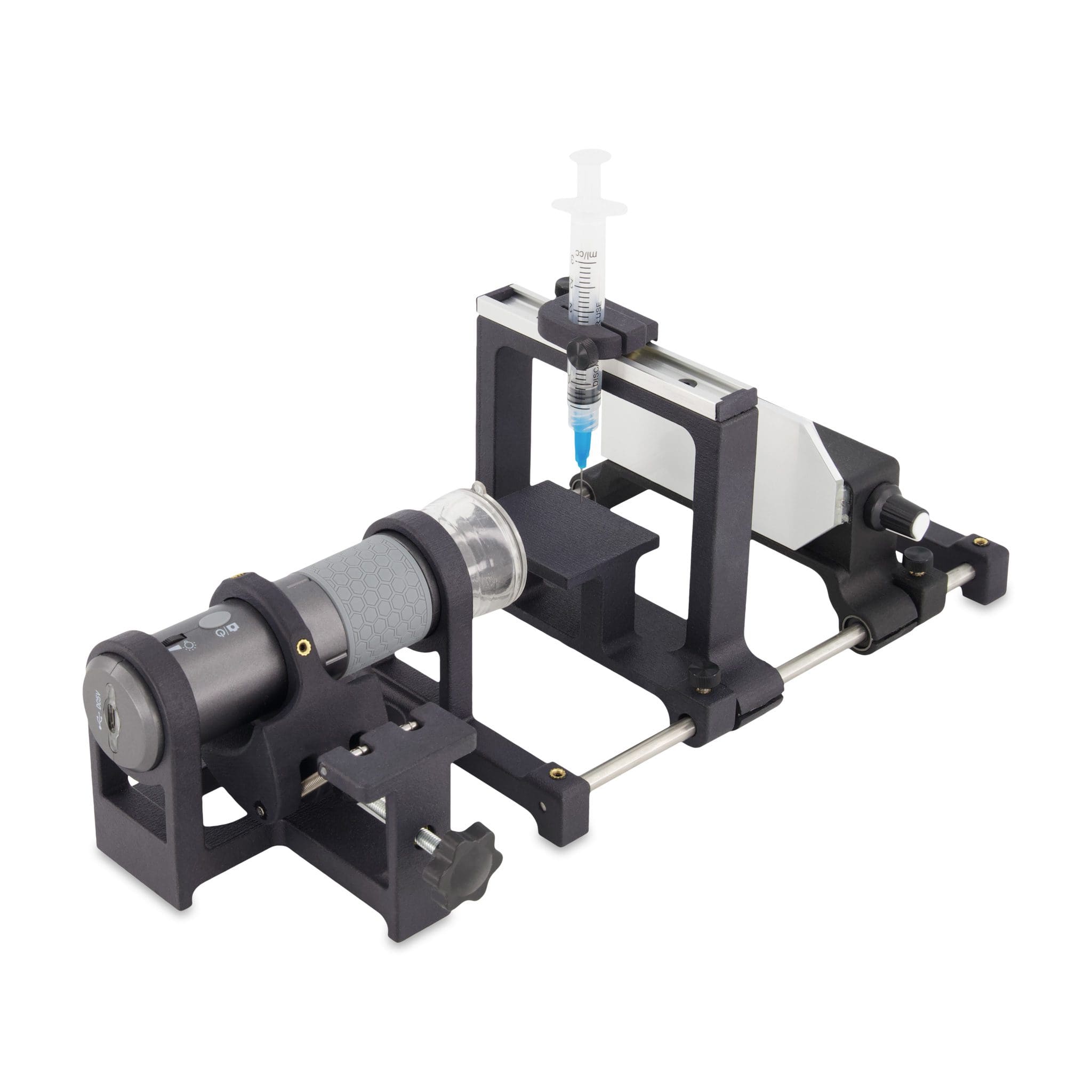
Droplet Lab Education Kit classroom contact angle instrument with camera and sample stage

Top pick

Droplet Lab Education Kit

US$999 per unit, US$869 each for 10 or more · checked 2026-10-23 · Education Kit product page

4.01/ 5

The Droplet Lab Education Kit ranks first because it is the only option here priced for a whole class that still ships with software and ready lab handouts. It scores lowest of the two Droplet Lab instruments on accuracy, scope and upgrade path.

Where it wins

  • US$999 per unit; US$949 for 3 to 4, US$899 for 5 to 9, US$869 for 10 or more
  • Contact angle and surface tension software with lifetime licences
  • POGIL aligned experiments ready to hand out
  • Assembles in about five minutes; 3D printed parts you can reprint

Where it loses ground

  • No published accuracy figure for the kit itself
  • Camera based with desktop software, so each station needs a computer
  • 1 year warranty
  • No add on stages listed
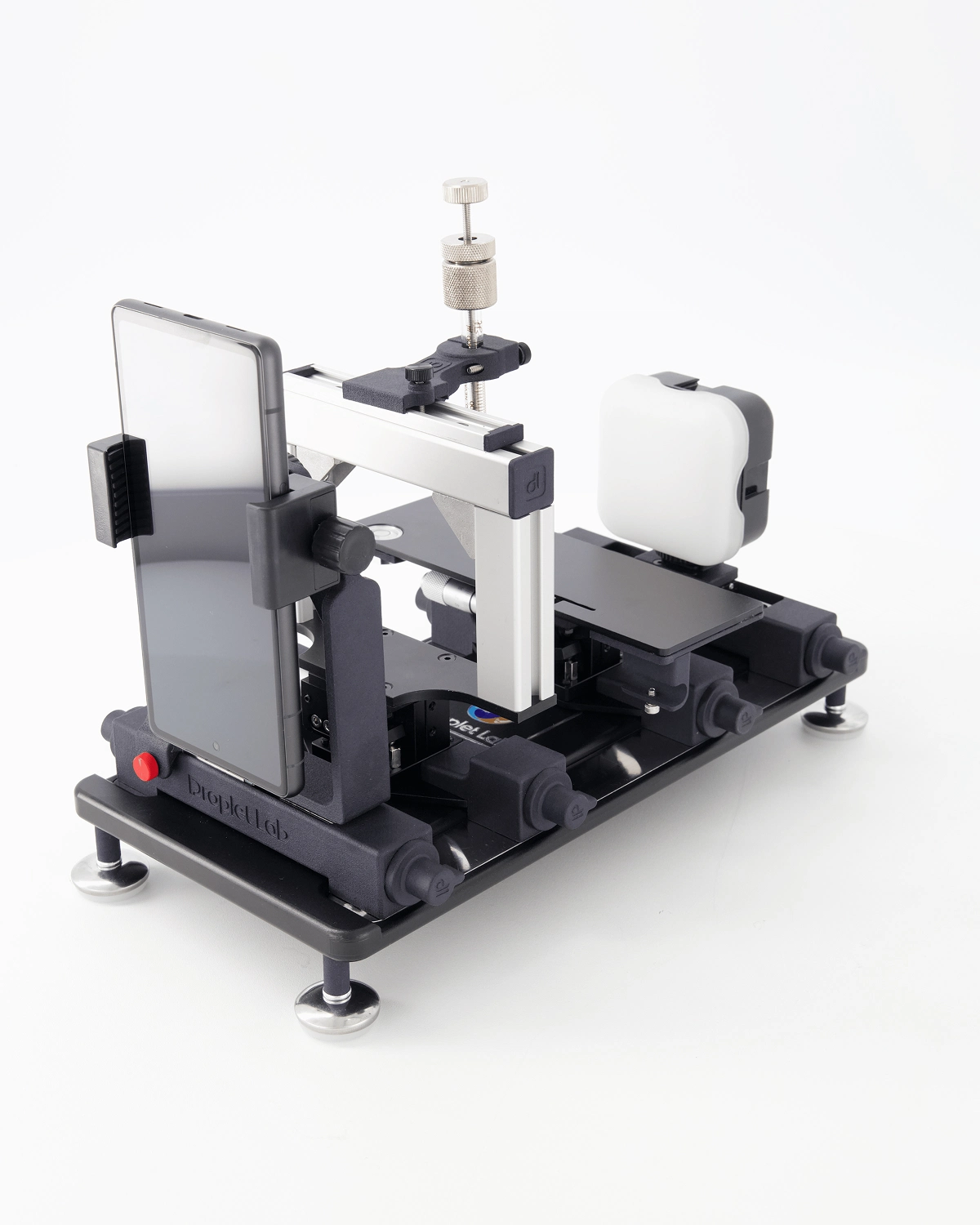
Dropometer contact angle kit: smartphone on a stage above a sessile drop, with a backlight

Runner up

Dropometer

US$4,990 list price, base kit · checked 2026-10-23 · Droplet Lab quote configurator

3.91/ 5

The Dropometer contact angle and surface tension kit is the research instrument students meet in grad school, with dynamic angle, surface energy and a published accuracy figure. At US$4,990 a unit it loses heavily on cost per station.

Where it wins

  • 0.35° accuracy against a KRÜSS DSA100E in peer review
  • Static and dynamic angle, surface tension and surface free energy
  • Runs on the included phone; no PC needed
  • 5 year warranty; lifetime licence for unlimited users

Where it loses ground

  • US$4,990 per unit; a class set costs five times the Education Kit
  • No lab handouts in the box
  • Sliding angle needs the US$700 tilt stage
Home built contact angle rig: camera on a tripod, sample stage and light source

Third

DIY: camera and ImageJ

Free software plus a camera, about US$20 to US$1,000 · checked 2026-10-23 · OpenDrop paper (camera cost)

2.55/ 5

A DIY rig teaches the principle well and costs least, but each station takes staff time to build and align, and students trace drops by hand. See our DIY ImageJ vs Dropometer comparison.

Where it wins

  • Free software: the ImageJ Contact Angle plugin, LB-ADSA, or OpenDrop for surface tension too
  • The OpenDrop authors put the camera at about US$20 to US$1,000
  • The best way to learn drop shape analysis before spending a budget

Where it loses ground

  • No stated accuracy; results depend on your camera, lighting and alignment
  • Manual or semi automatic tracing is slow beyond a few samples
  • Results vary between operators
  • No warranty, support or upgrade path

How we arrived at these scores

Each option is scored from 1 to 5 on the same 11 criteria used across our contact angle guides. A 3 meets what a teaching lab needs; a 5 exceeds it. The weights are set for classroom use and add to 100 percent, with cost per station carrying the most because a teaching lab buys several stations. Multiply each score by its weight, add the rows and divide by 100: that is the headline score.

Weighted scorecard
CriterionWhat it measuresWeight (%)Droplet Lab Education KitDropometerDIY: camera and ImageJWhy these scores
Five year cost of ownershipCost per student station over five years, including software and a computer524.5Education Kit US$999 per unit, US$869 each for 10 or more. Dropometer US$4,990 per unit. DIY: free software plus a camera, but staff time to build and align each rig.
Measurement scopeThe experiments a class can run: contact angle, surface tension, surface energy, hysteresis44.52.5Education Kit: contact angle and surface tension software with POGIL aligned experiments. Dropometer adds dynamic angle and surface energy models. DIY: static angle; surface tension with OpenDrop.
Portability and setupTime from box to first measurement and how easily it moves between rooms4.54.52Education Kit assembles in about five minutes. Dropometer sets up in about 2 minutes on battery. DIY rigs need aligning before each session.
Operator independenceWhether different students get the same answer from the same drop3.551.5Education Kit software guides each measurement. Dropometer detects edge and baseline automatically. DIY tracing varies by student.
Software and platformLicence terms and teaching material included4.543Education Kit: lifetime licences and POGIL aligned experiments. Dropometer: lifetime licence, unlimited users, iOS and Android. DIY: free plugins, no lesson material.
Published accuracyAccuracy against a reference instrument2.551.5Dropometer: 0.35° against a KRÜSS DSA100E in peer review. The Education Kit has no published accuracy figure of its own. DIY: depends on your optics.
Time per sampleHow many measurements a group completes in one lab session441.5Both Droplet Lab instruments fit the drop in software; manual DIY tracing is slow.
RecordsImages and results students can hand in and recheck3.541.5Both Droplet Lab instruments save images and results; DIY depends on student file habits.
WarrantyWarranty length and repair351Education Kit 1 year, and you can reprint broken parts yourself. Dropometer 5 years. DIY: none.
Optics and image qualityCamera and lighting for a sharp drop edge3.542Education Kit 4K Wi-Fi camera. Dropometer 50 MP phone camera with backlight. DIY: whatever camera you have.
Upgrade pathCapability you can add later252Dropometer: tilt stage, auto dropper, auto tilt. No add ons listed for the Education Kit. DIY: rebuild.
Weighted total / 54.013.912.55

Side by side specifications

The specifications that decide a teaching lab purchase, from each maker's own pages. Checked 23 October 2026.

SpecificationEducation KitDropometerDIY (camera + free software)
Price per unitUS$999; US$869 each for 10 or moreUS$4,990 base kit (phone included)Free software; camera about US$20 to US$1,000
Class set of 10US$8,690US$49,900Cameras plus staff build time
MedidasContact angle and surface tensionStatic and dynamic contact angle, surface tension, surface free energyStatic angle (ImageJ); surface tension with OpenDrop
Teaching materialPOGIL aligned experiments includedFree experiments in the Surface Science HubNone
Camera and computer4K Wi-Fi camera; desktop software on a lab computerRuns on the included phoneYour own camera and computer
SetupAbout five minutesAbout 2 minutesBuild and align each rig
Stated accuracyNot published for the kit0.35° (peer reviewed, vs KRÜSS DSA100E)Not stated
Warranty1 year; reprintable parts5 yearsNone

Sources: Education Kit product page; Dropometer product page; OpenDrop (Huang et al., 2021). All checked 23 October 2026.

When not to buy a Dropometer

  • You need several stations for an introductory class; the Education Kit costs about a fifth as much. Education Kit
  • You want students to learn drop shape analysis by tracing drops themselves. DIY ImageJ vs Dropometer
  • Your teaching needs high speed imaging or temperature control. Advanced research guide

Verified on 2026-10-23

Prices and specifications checked 23 October 2026. Sources are listed in the guide references.

Expert perspective

A contact angle is a thermodynamic property: fix the liquid and the solid and the same angle appears whether the drop sits on a plate or climbs a capillary.

Dra. Alidad AmirfazliCo-founder and Scientific Advisor, Droplet Lab; Professor of Mechanical Engineering, York University

Frequently asked questions

How many contact angle instruments does a teaching lab need?

Enough for groups of two to four students per station in one session. The Education Kit page says most classrooms order three to four units.

What is the difference between the Education Kit and the Dropometer?

The Education Kit is a camera based instrument with desktop software, priced and built for teaching. The Dropometer is the smartphone based research and QC kit, with dynamic angle, surface energy and a published 0.35° accuracy figure.

Is the Education Kit accurate enough for teaching?

For teaching wetting trends and method, yes. It has no published accuracy figure of its own, so use the Dropometer where students produce data for a paper or a thesis.

Which experiments can students run?

Treated against untreated surfaces, surfactants and surface tension, and advancing and receding angles. Our contact angle measurement guide gives the background for each.

Can students build their own goniometer instead?

Yes. A camera, a light, a stage and the free ImageJ Contact Angle plugin measure static angle, and building one teaches the principle well. Expect slow manual tracing. See our DIY comparison.

Do classroom sets get a discount?

Yes. The Education Kit is US$949 each for 3 to 4 units, US$899 for 5 to 9 and US$869 for 10 or more.

Referencias

1.
Droplet Lab Education Kit product pageUS$999 per unit, classroom set pricing, 4K Wi-Fi camera, software licences and 1 year warranty; checked 23 October 2026
2.
University of South Florida case study, Droplet Lab33 teaching kits across two buildings; research kit ruled out for a class set
3.
Dropometer product page and specifications, Droplet LabSpecifications, battery operation, offline analysis, export and add ons; checked 23 October 2026
4.
Droplet Lab quote configuratorUS$4,990 base kit and add on prices; checked 23 October 2026
6.
Droplet Lab validation papersBoth peer reviewed validation studies
7.
Brugnara M. Contact Angle plugin for ImageJFree ImageJ plugin for static contact angle

Plan your teaching lab

Book a 15 minute call and we will size a class set with you, or request a quote for the Education Kit.