Best Contact Angle Goniometer for Advanced Research
Advanced research needs the widest scope, the best optics and data a reviewer will accept. This guide ranks three options, shows every weight and score, and says when a US$4,990 kit is enough.
Holds a BASc in Mechanical Engineering from Ryerson University (now Toronto Metropolitan University) and an MASc from York University. He develops the automatic edge and baseline detection behind the Dropometer's analysis.
Holds a BASc in Mechanical Engineering from Ryerson University (now Toronto Metropolitan University) and an MASc from York University. He develops the automatic edge and baseline detection behind the Dropometer's analysis.
A premium benchtop goniometer (KRÜSS DSA100, Biolin Theta Flex or DataPhysics OCA) is our pick for advanced research. They are quote only; KRÜSS lists a refurbished DSA100S at €23,864. They lead on high speed optics, automated dosing and temperature or humidity chambers. The Dropometer (US$4,990) is the runner up and the better buy for a group that needs static and dynamic angle, surface tension and surface energy without high speed or environmental work.
We make the Dropometer and it does not win here. Every weight and score is below for you to check. New to the method? Start with our contact angle measurement guide.
The ranking
Three options at three price points: a premium benchtop system, a portable research kit and an entry benchtop goniometer.
Pick by situation
If you study fast spreading, impact or evaporation, or need temperature or humidity control:Premium benchtop. High speed cameras and environmental chambers that a portable kit does not offer.
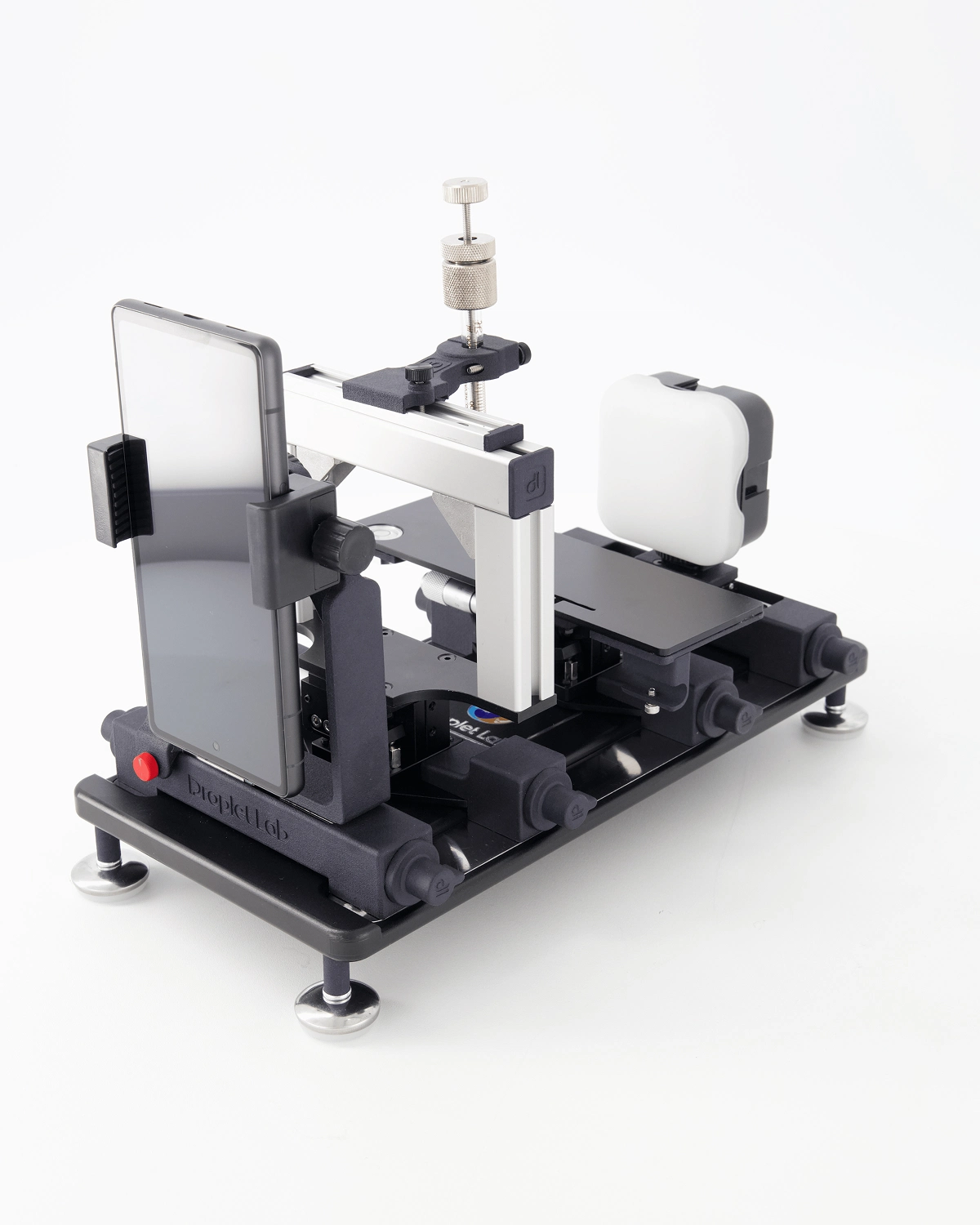
If you need static and dynamic angle, surface tension and surface energy on a group budget:Dropometer. One US$4,990 kit with 0.35° published accuracy and TIFF image export.
If you share one instrument across many users and samples:Premium benchtop with automated dosing. Motorised axes and multi syringe dosing keep results consistent between users.
If you only need static angle on flat samples:Ossila goniometer. About US$3,000 for the single measurement you need.
Also checked and not ranked separately: the ramé-hart range, which ramé-hart puts at about US$5,000 to US$25,000, and the KRÜSS DSA25, listed refurbished at €13,311 to €14,283. Both are scored inside the premium benchtop group. A DIY camera and ImageJ rig was not ranked: it cannot give the stated accuracy a reviewer will ask for.
New units not published (quote only); refurbished KRÜSS DSA100S €23,864 excluding VAT · checked 2026-10-25 · KRÜSS refurbished shop, DSA100S r04
4.43/ 5
Premium benchtops rank first because they cover every research measurement on one platform and lead on optics, automation and environment control. They take the lowest cost score by a wide margin, and that is the only criterion that keeps the total below 5.
Where it wins
0.1° stated accuracy across KRÜSS, Biolin and DataPhysics
High speed cameras: up to 3,450 frames per second on the KRÜSS DSA100
Up to 8 dosing liquids and motorised axes for automated series
Tilting bases and temperature chambers from -30 °C
Surface energy models from Zisman to acid base
Where it loses ground
Quote only; budget for modules, installation and training on top
Fixed benchtop install, not portable
Warranty and service terms not published
21 CFR Part 11 or audit trail options are not stated on the public pages we read; ask in writing if you need them
The Dropometer contact angle and surface tension kit covers most research measurements for less than a quarter of the price of a refurbished premium system. It matches premium systems on operator independence and comes close on published accuracy. It loses on optics speed, automation depth and environment control.
Where it wins
Static and dynamic contact angle, pendant drop surface and interfacial tension, and surface free energy
0.35° accuracy against a KRÜSS DSA100E in two peer reviewed papers
TIFF images and CSV results for reanalysis
Auto dropper (US$2,000) and auto tilt stage (US$1,500) add ons
5 year warranty; lifetime software licence
Where it loses ground
No high speed camera mode for impact or spreading studies
No temperature or humidity chamber in the standard range
Contact angle range 10° to 175°
Sliding angle needs the US$700 tilt stage
Third
Ossila Contact Angle Goniometer
About US$3,000 list price excluding VAT, PC not included · checked 2026-10-23 · Ossila product page
2.83/ 5
Ossila is a capable entry benchtop for static angle on flat samples, at the lowest price here. For advanced research it lacks dynamic methods, surface energy and a published validation. Our Dropometer vs Ossila comparison goes point by point.
Where it wins
About US$3,000, about US$2,000 less than the Dropometer
Wide contact angle range: 5° to 180°
±1° stated accuracy and a 1080p camera
Two year warranty and free software updates
Where it loses ground
Static contact angle and pendant drop surface tension only
No published validation against a reference instrument
Runs from mains through the included 24 V adapter and needs a Windows 11 PC your lab provides
No tilt stage or automatic dosing listed
How we arrived at these scores
Each option is scored from 1 to 5 on the same 11 criteria used across our contact angle guides. A 3 meets what a research group needs; a 5 exceeds it. The weights are set for advanced research and add to 100 percent. Multiply each score by its weight, add the rows and divide by 100: that is the headline score. The premium benchtop column scores the group of KRÜSS DSA100, Biolin Theta Flex and DataPhysics OCA, using each maker's own data sheets.
Static, advancing and receding, sliding angle, surface free energy and pendant drop tension on one platform
5
4
2.5
Premium systems add tilting bases and temperature or humidity chambers. Dropometer covers static, dynamic, surface tension and surface energy; sliding angle needs the US$700 tilt stage. Ossila states static angle and pendant drop only.
Published accuracy
Accuracy against a reference, not display resolution
5
4.5
3
KRÜSS, Biolin and DataPhysics state 0.1°. Dropometer: 0.35° against a KRÜSS DSA100E in peer review. Ossila: ±1° stated by the maker.
Optics and image quality
Camera speed, magnification and focus for fast or small drops
5
3.5
3
KRÜSS cameras reach 2,300 to 3,450 frames per second and Theta Flex 2,347. Dropometer uses a 50 MP phone camera with LED backlight. Ossila uses a 1080p USB camera with manual focus.
Upgrade path
Automation, dosing and environment modules you can add
5
3.5
1.5
Premium: up to 8 dosing liquids, motorised axes, chambers from -30 °C. Dropometer: auto dropper and auto tilt stage. Ossila lists no add on stages.
Operator independence
The same image gives the same reading whoever measures
4.5
4.5
3
Automatic baseline and edge detection on premium systems and the Dropometer; Ossila fits in software after manual setup.
Records
Raw images and results you can reanalyse for a paper or a reviewer
4.5
3.5
3
Premium software stores and reanalyses image series. Dropometer exports TIFF images and CSV results. Ossila saves images with results.
Five year cost of ownership
Purchase, modules, service and computer over five years
1.5
4
4.5
Premium: quote only; KRÜSS lists a refurbished DSA100S at €23,864. Dropometer US$4,990 with phone and lifetime licence. Ossila about US$3,000 plus a PC.
Software and analysis models
Fitting methods and surface energy models available
5
4
2.5
Biolin lists Zisman, OWRK, van Oss, Wu, Neumann and Schultz; DataPhysics lists 9 theories. Dropometer: Young-Laplace, Fowkes, van Oss-Chaudhury-Good and equation of state, plus a free OWRK calculator. Ossila: no surface energy model stated.
Time per sample
Hands on time from drop to recorded result
4.5
4
3.5
Automated dosing and fitting on premium systems; software fitting on the other two.
Warranty
Warranty length
2
5
3
Premium makers do not publish warranty terms; ask. Dropometer 5 years. Ossila 2 years.
Portability and setup
Moving between labs and setup time
1.5
5
2.5
Premium systems are fixed benchtop installs. Dropometer sets up in about 2 minutes. Ossila needs mains power and a PC.
Weighted total / 5
4.43
4.01
2.83
Side by side specifications
The specifications that decide a research purchase, from each maker's own pages and data sheets. Checked 23 October 2026.
Specifications checked 23 October 2026; Biolin Theta Flex frame rate and the refurbished KRÜSS DSA100S price rechecked 25 October 2026. Sources are listed in the guide references.
Expert perspective
“
The gap between the advancing and receding angle, the hysteresis, is where a surface reveals its roughness, its heterogeneity, and whether something is reacting.
Dra. Alidad AmirfazliCo-founder and Scientific Advisor, Droplet Lab; Professor of Mechanical Engineering, York University
Head to head comparisons
The full comparison for each instrument named on this page.
What makes a contact angle goniometer research grade?
A published accuracy figure against a reference, advancing and receding angle rather than a single static reading, raw images you can reanalyse, and surface energy models you can name in a methods section. High speed optics and environment control matter only if your study needs them.
Is 0.1° accuracy worth paying for over 0.35°?
Only if your differences are that small. Hysteresis on real surfaces is often several degrees, so method and repeat count usually matter more than the last tenth of a degree. Our 10 steps to reproducible contact angle covers the method side.
Can a portable goniometer give publishable data?
Yes, when its accuracy is validated against a reference instrument. The Dropometer's contact angle and pendant drop results were compared with a KRÜSS DSA100E in two peer reviewed papers.
We could not confirm a Part 11 option on the public KRÜSS, Biolin or DataPhysics pages we read on 23 October 2026. Ask each vendor in writing. The Dropometer does not support audit trails or electronic signatures; see our ISO/GLP guide.
Should a research group buy one premium system or several portable kits?
Count users and measurement types. One premium system suits a shared facility with high speed or chamber work. Several portable kits suit groups where many people need contact angle and surface tension at their own bench.